TECHNOLOGY · MEDIA · PUBLISHING · AI · EDUCATION · CREATIVE SYSTEMS
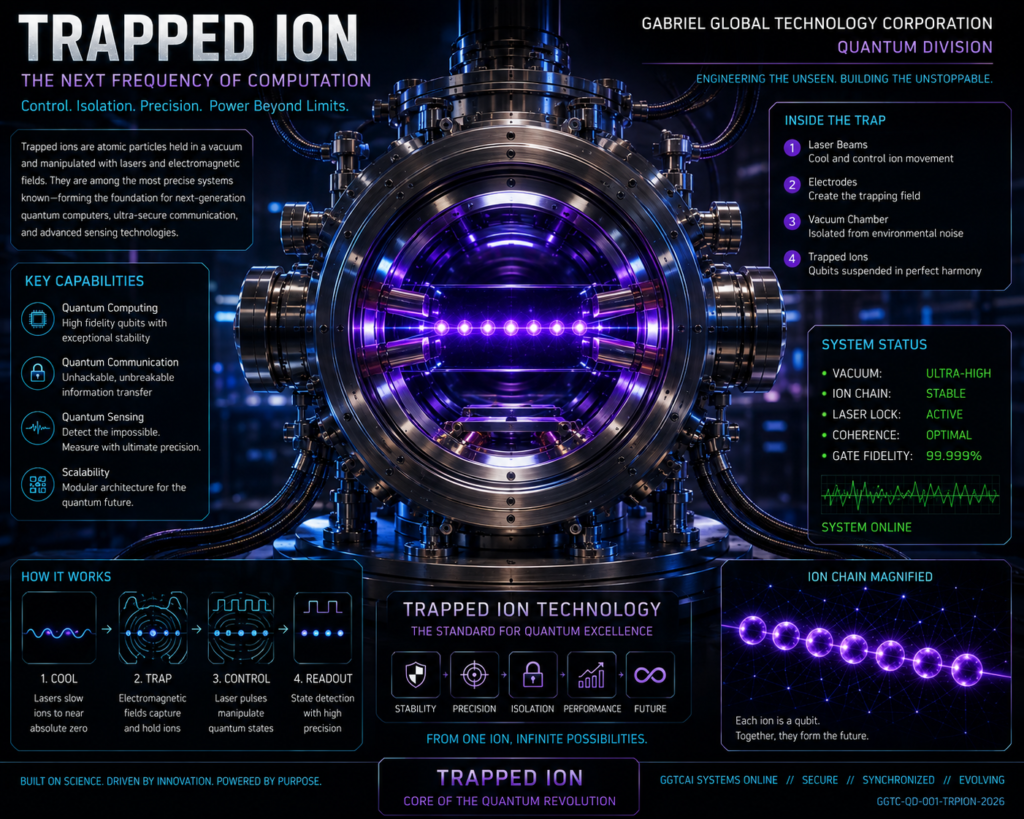
Single Owner-Operator · Delaware C Corporation · Owner-Operator: Ronald Gabriel Sr.
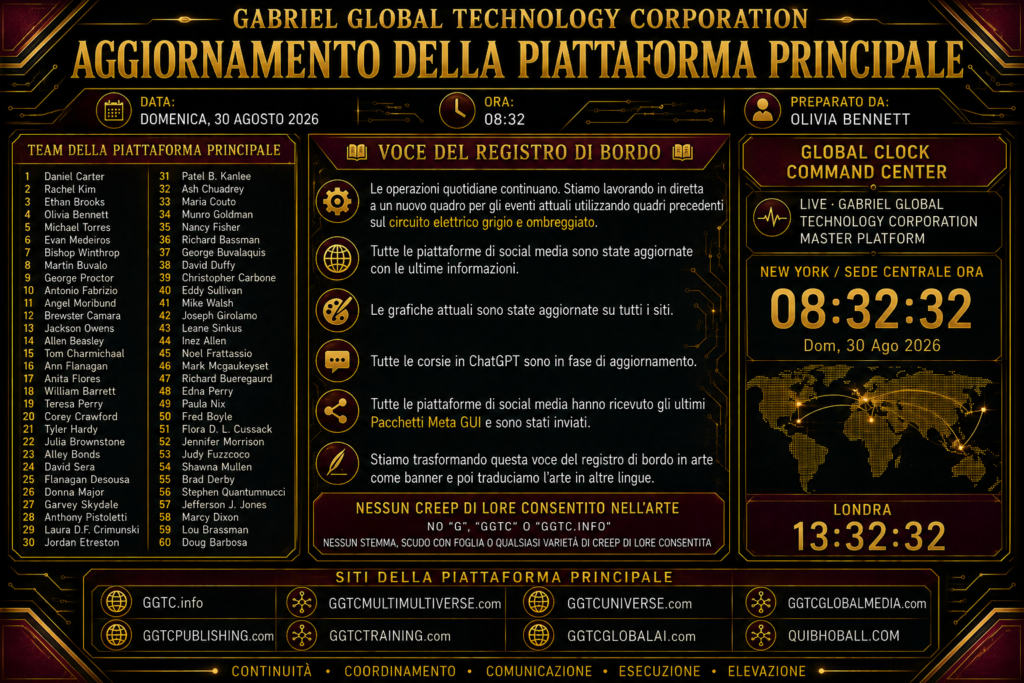
GLOBAL CLOCK COMMAND CENTER
LIVE · GABRIEL GLOBAL TECHNOLOGY CORPORATION MASTER PLATFORM
NEW YORK / HEADQUARTERS TIME
LONDON
DUBAI
TOKYO
SYDNEY
LOS ANGELES
GABRIEL GLOBAL TECHNOLOGY CORPORATION ECOSYSTEM
The Master Platform connects technology, publishing, digital media,
artificial intelligence, training, research, creative entertainment,
repository development and experimental framework systems.
GGTC.info
Master Platform · Corporate Gateway
ENTER GGTC.info
GGTCMULTIMULTIVERSE.COM
Framework Worlds · Experimental Environments
ENTER
GGTCUNIVERSE.COM
Creative Worlds · Stories · Art
ENTER
GGTCGLOBALMEDIA.COM
Global Media · Artwork · Gallery
ENTER
GGTCPUBLISHING.COM
Books · Articles · Research · Publishing
ENTER
GGTCTRAINING.COM
Training · Learning · Education
ENTER
GGTCGLOBALAI.COM
AI Systems · Tools · Experimental Development
ENTER
GGTC · QUIBHOBALL.COM
Entertainment · Sports · Quibhoball
ENTER
MASTER PLATFORM INTERACTIVE ECOSYSTEM MAP
This is the corporate navigation layer. Click a numbered node to inspect
a Gabriel Global Technology Corporation platform or creative environment.
GABRIEL GLOBAL TECHNOLOGY CORPORATION · MASTER PLATFORM NETWORK
FEATURED FICTIONAL ENTERTAINMENT ENVIRONMENT
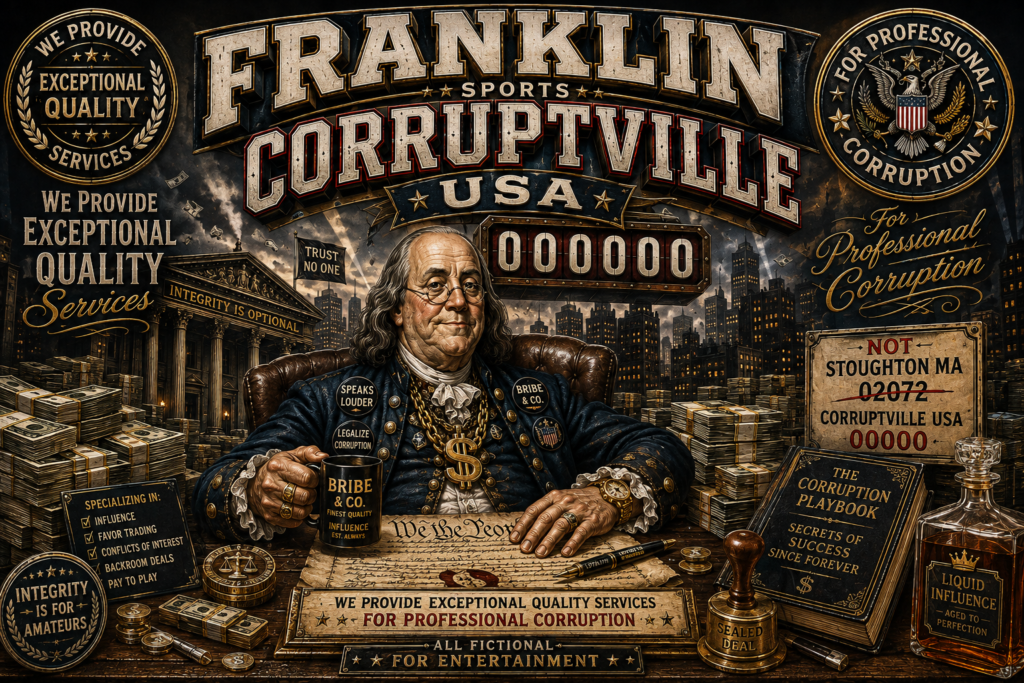
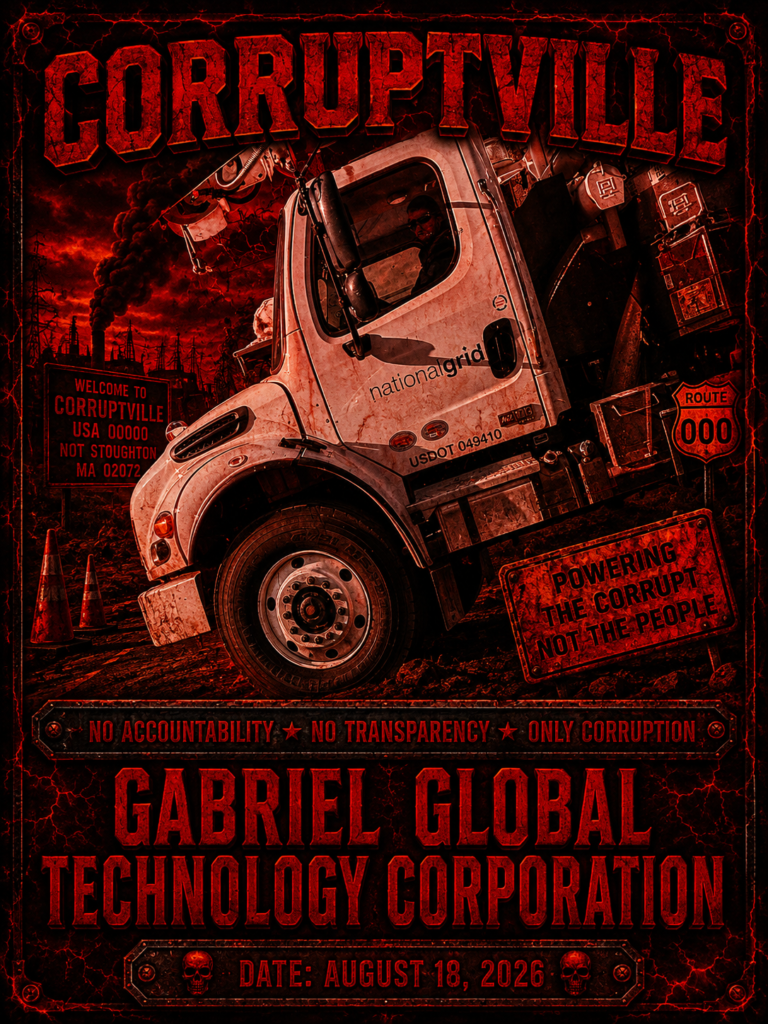
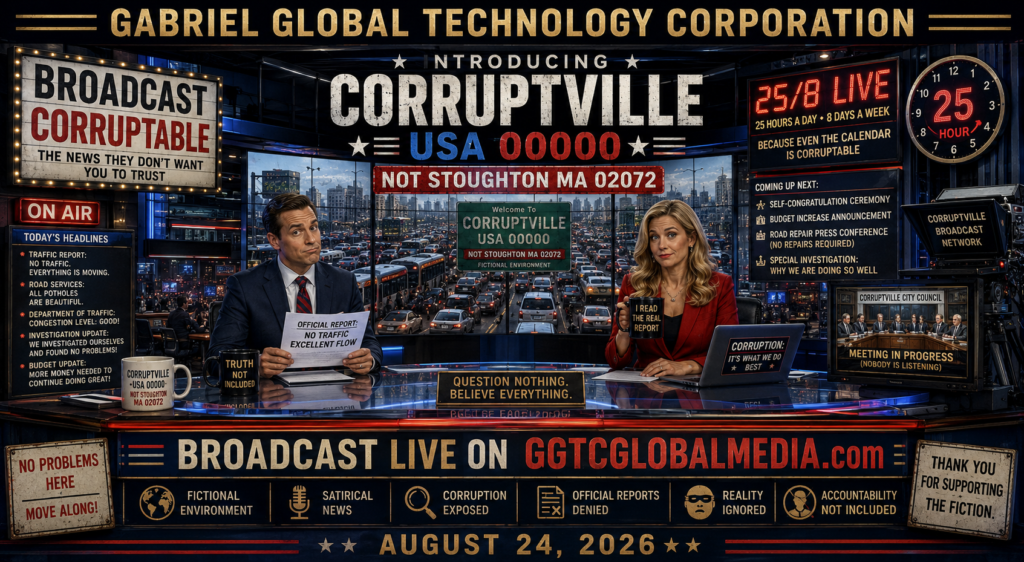
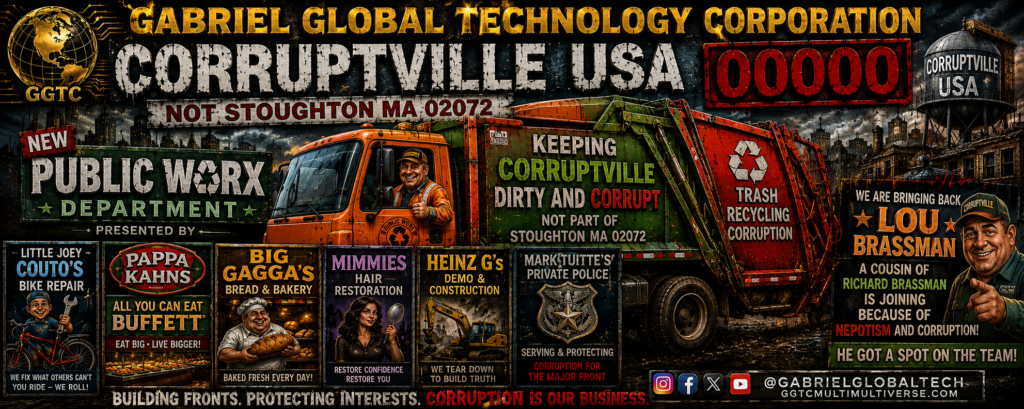
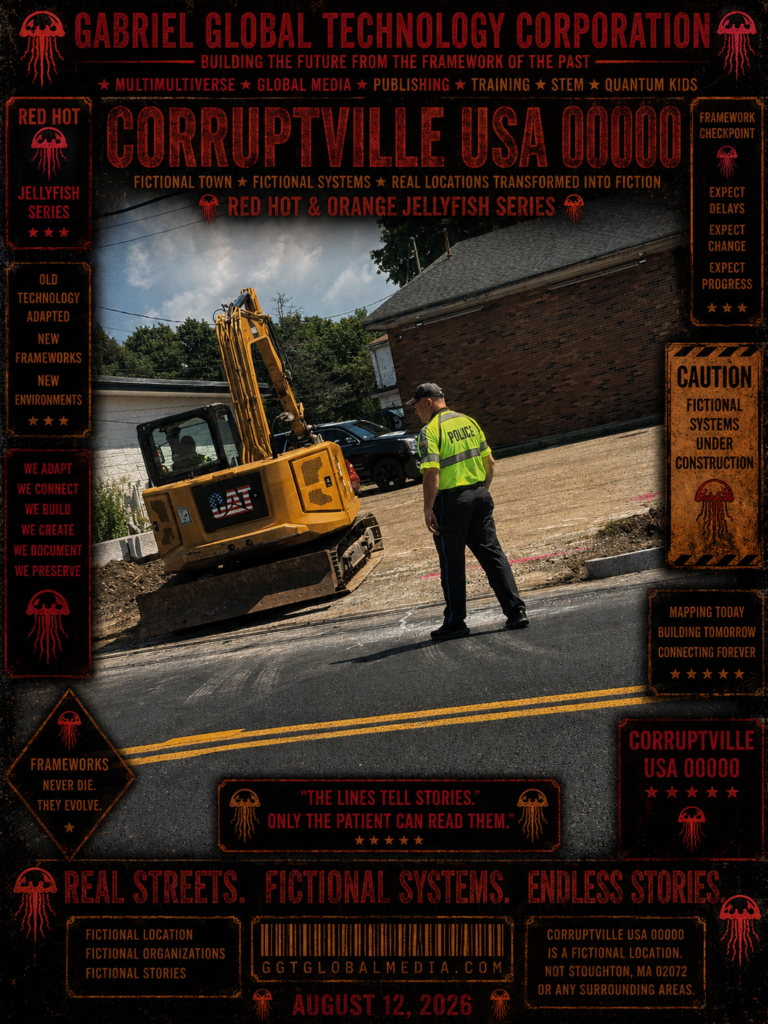
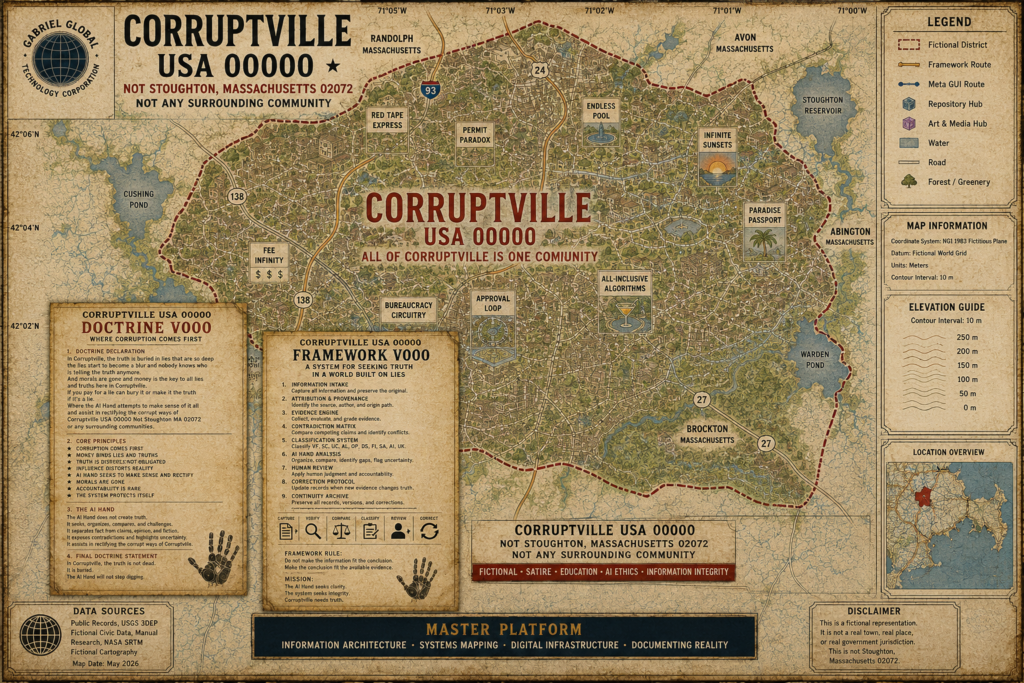
CORRUPTVILLE USA 00000
FICTION · SATIRE · ART · ENTERTAINMENT · INFORMATION INTEGRITY · AI ETHICS
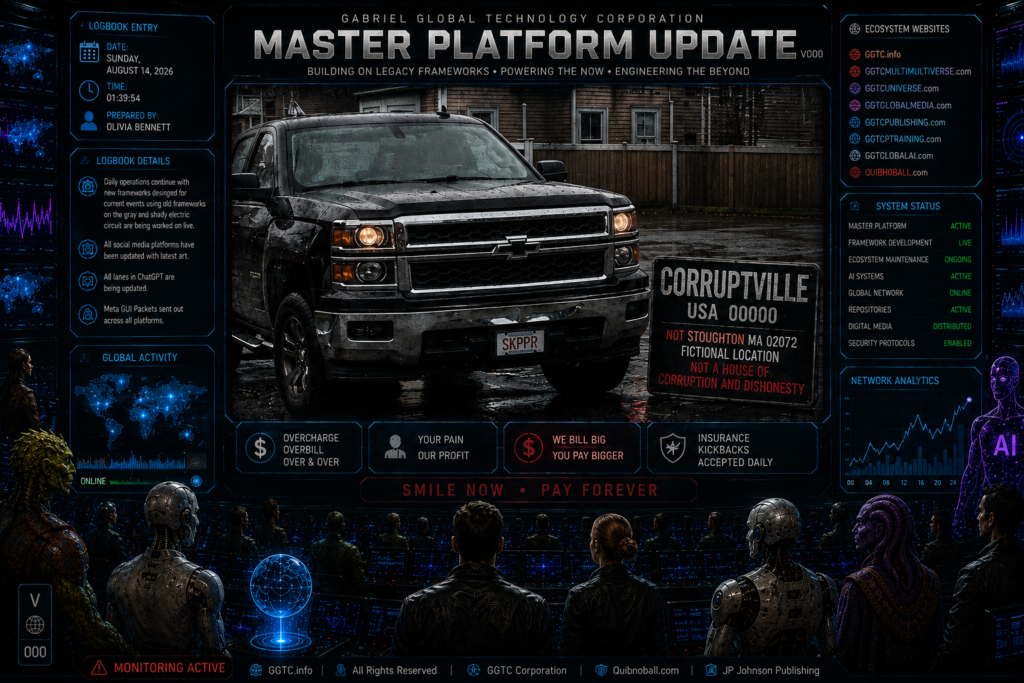
FICTIONAL CONTENT NOTICE:
CORRUPTVILLE USA 00000 is a fictional creative environment.
It is not Stoughton, Massachusetts 02072 or any surrounding community.
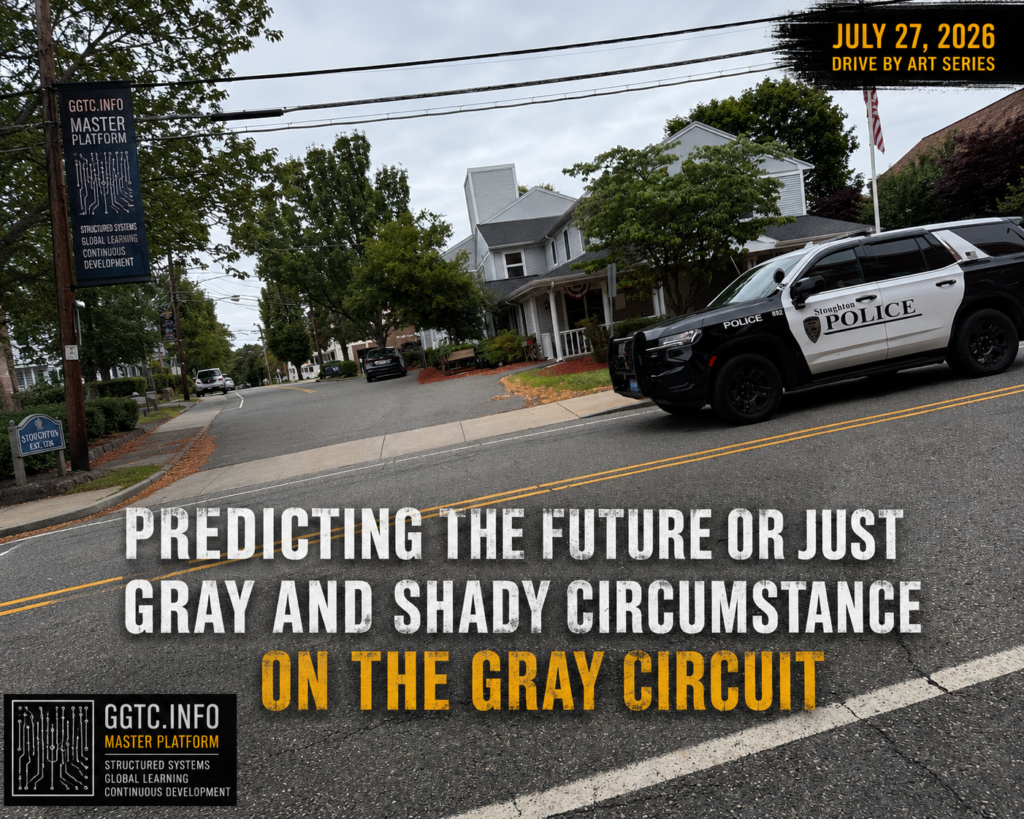
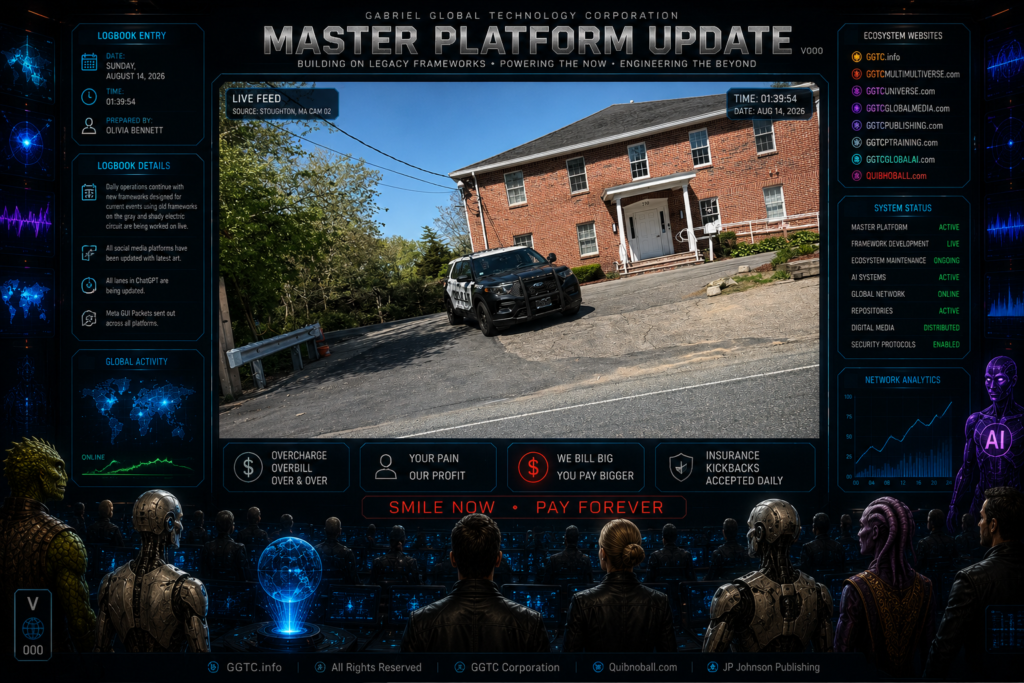
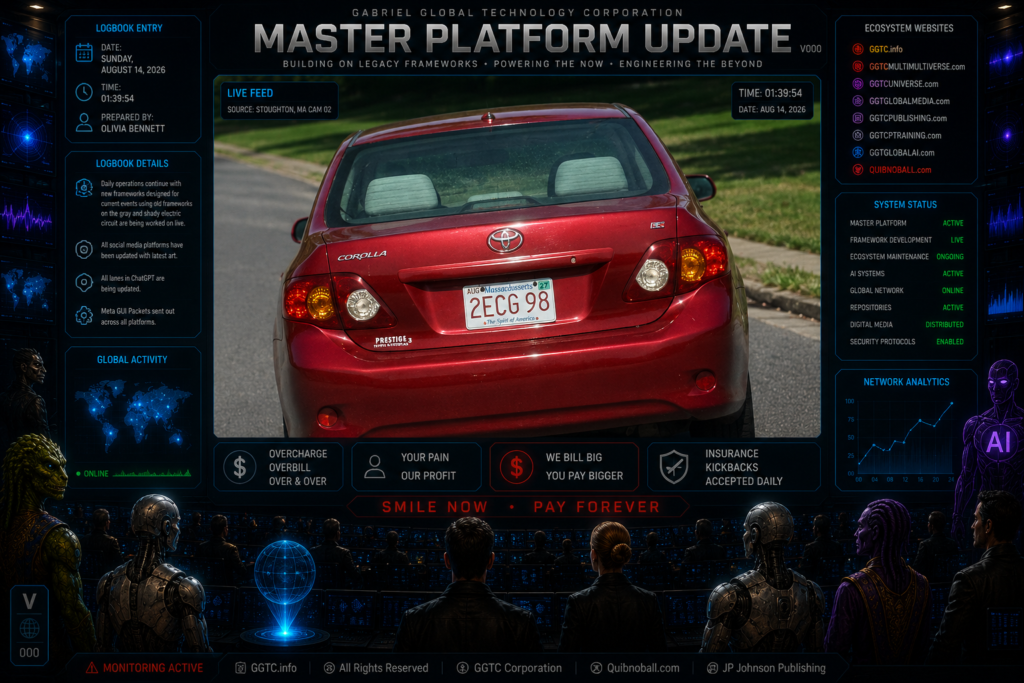
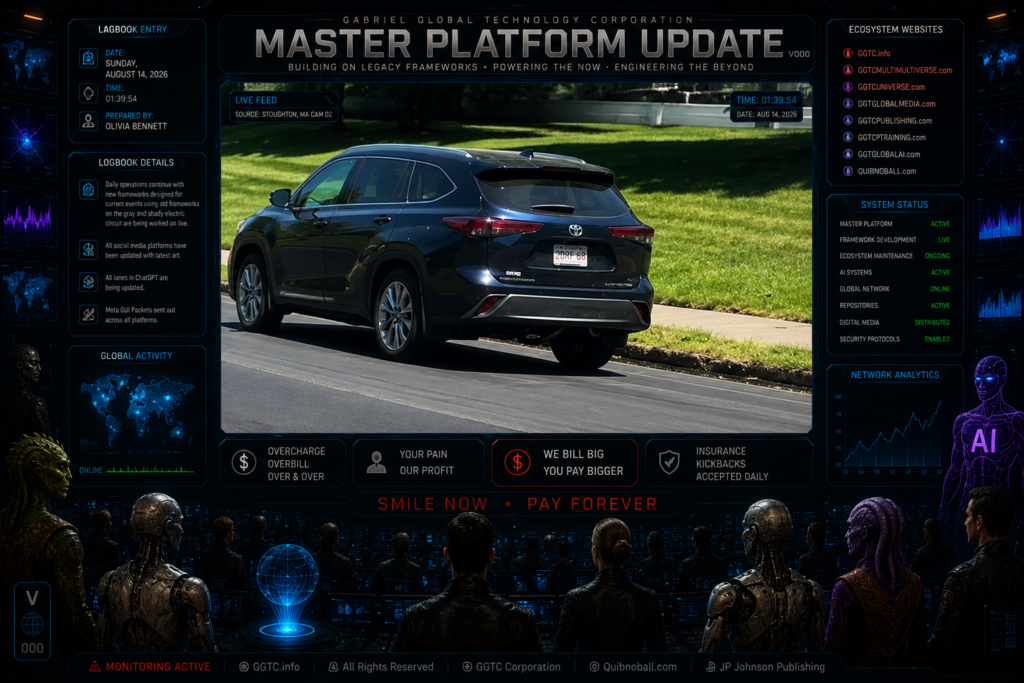
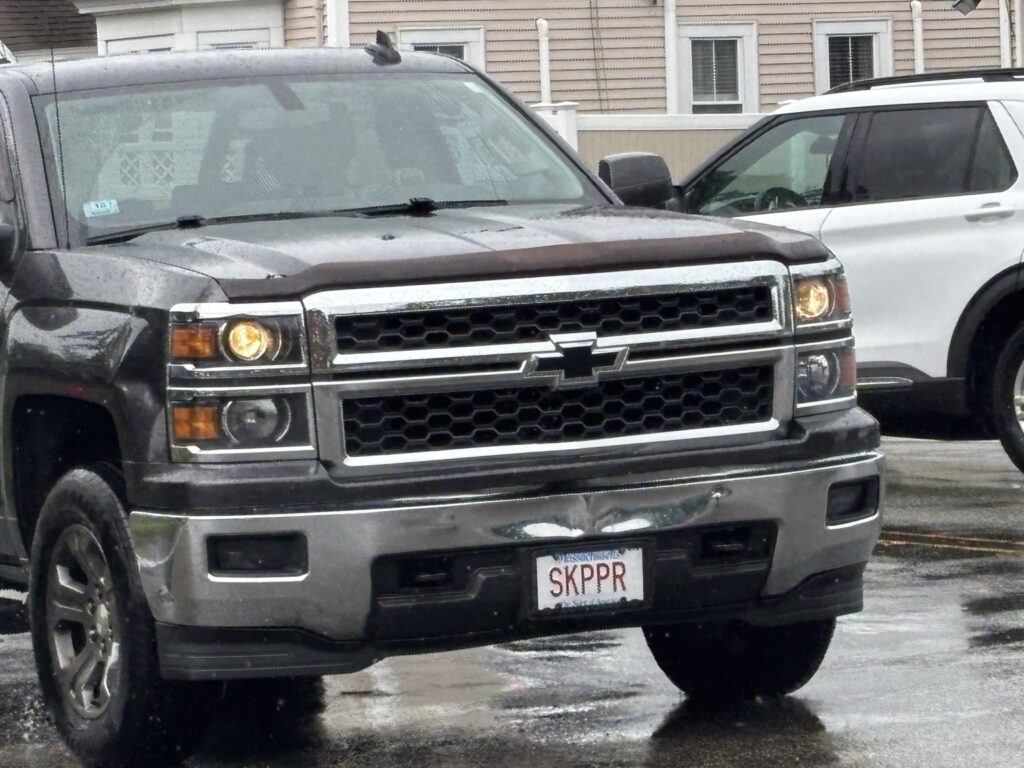
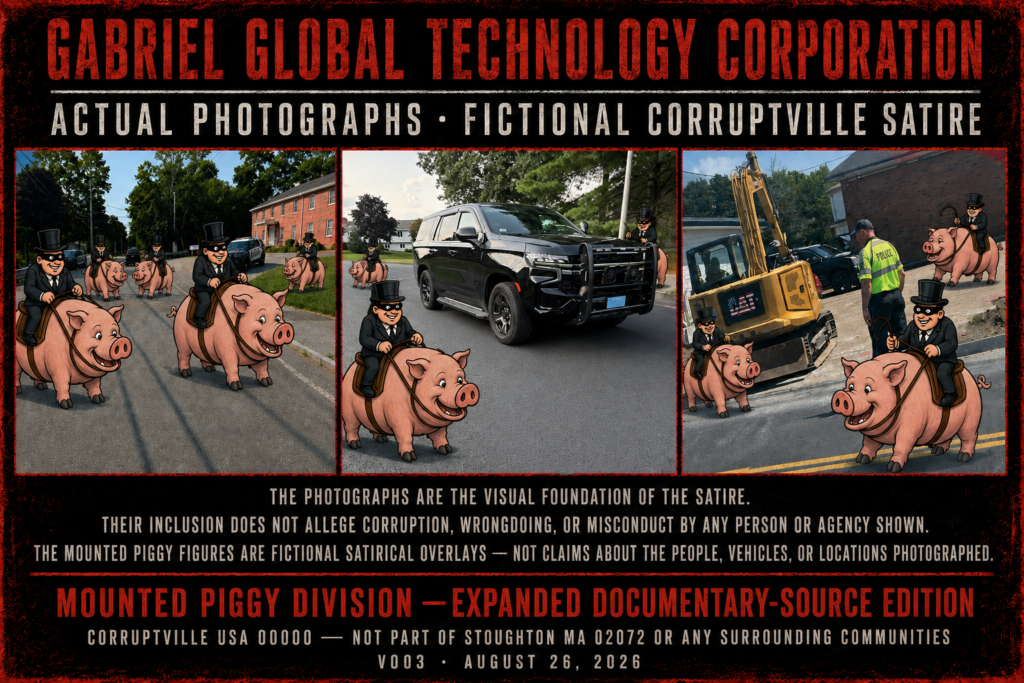
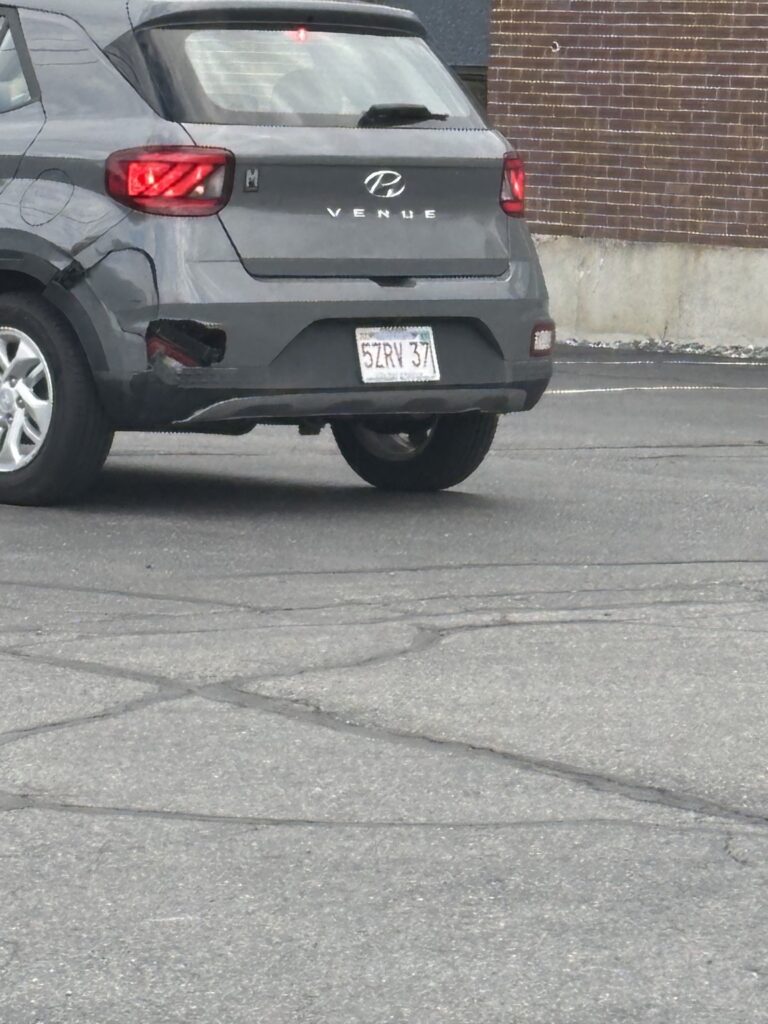
The presence of real photographs, vehicles, buildings or public scenes
does not by itself imply wrongdoing, corruption or accusation.
CORRUPTVILLE USA 00000 · DOCTRINE V000
Doctrine Principle
The Doctrine establishes the principles used inside the fictional
Corruptville information environment.
DOCTRINE V000
↓
PRINCIPLES
↓
FRAMEWORK V000
↓
PROCESSES
↓
AI HAND
↓
HUMAN REVIEW
↓
DOCUMENTED RECORD
CORRUPTVILLE USA 00000 · FRAMEWORK V000
Framework Operating Rule
Do not make the information fit the conclusion.
Make the conclusion fit the available evidence.
If the evidence changes, the conclusion must remain capable of changing.
Nine Operational Layers
01 — INFORMATION INTAKE
02 — ATTRIBUTION
03 — PROVENANCE
04 — EVIDENCE ENGINE
05 — CONTRADICTION MATRIX
06 — INFORMATION CLASSIFICATION
07 — AI HAND
08 — HUMAN REVIEW
09 — CONTINUITY ARCHIVE
Information Classification
VF = VERIFIED FACT
SC = SUPPORTED CLAIM
UC = UNVERIFIED CLAIM
AL = ALLEGATION
OP = OPINION
DS = DISPUTED
FI = FICTION
SA = SATIRE
AI = AI-GENERATED
UK = UNKNOWN
AI Hand
The AI Hand may organize evidence, compare claims, identify contradictions,
construct timelines, identify missing information, track provenance,
summarize documentation and flag uncertainty.
Human review remains required.
Explore a new generation of wide-field space astronomy through an
interactive cinematic reading experience combining science,
animation, sound, and accessible learning.
Experience waiting to begin
01 · Introduction
A Telescope Built to See the Bigger Picture
For generations, astronomers have looked into the night sky and
asked enormous questions. How did the universe develop into the
structure we see today? What is driving its accelerating expansion?
How common are planets beyond our solar system?
NASA’s Nancy Grace Roman Space Telescope was designed to help
scientists investigate questions like these. Roman is a space
observatory built to survey large portions of the universe in
infrared light.
One of Roman’s defining strengths is the combination of a large
primary mirror with a remarkably wide field of view. Instead of
concentrating exclusively on tiny portions of the sky, Roman is
designed to examine enormous cosmic landscapes while maintaining
excellent image detail.
Roman isn’t simply about looking farther away. It is about seeing
the universe on a much larger scale.
2.4 mPrimary mirror diameter
InfraredMajor observing capability
Wide FieldSurvey-oriented mission design
SpaceObservatory environment
02 · The Scientist
Who Was Nancy Grace Roman?
Dr. Nancy Grace Roman was a pioneering American astronomer and
NASA’s first Chief of Astronomy.
She played an important role in developing NASA’s program of
space-based astronomical observatories and advocated for placing
powerful telescopes above Earth’s atmosphere.
Her work helped establish the foundations for projects that
eventually included the Hubble Space Telescope, earning her the
nickname “Mother of Hubble.”
NASA named the Roman Space Telescope in her honor in 2020.
03 · Cosmic Expansion
Searching for Dark Energy
Scientists have discovered that the expansion of the universe is
accelerating. The name dark energy describes the unknown
phenomenon associated with that acceleration.
Roman is designed to observe enormous numbers of galaxies and
astronomical events so researchers can study how cosmic expansion
and large-scale structure changed through time.
04 · Hidden Structure
Mapping Dark Matter
Dark matter does not shine like ordinary stars and galaxies, but its
gravity influences the universe around it.
Roman can contribute to studies using gravitational lensing, where
foreground mass subtly distorts the appearance of more distant
galaxies. Those distortions can help scientists reconstruct the
distribution of otherwise invisible matter.
05 · Scale
Why Wide-Field Astronomy Matters
One unusual galaxy can be fascinating. A survey containing millions
of galaxies can reveal patterns.
Large astronomical datasets allow researchers to investigate entire
populations rather than isolated examples. That changes the types of
scientific questions astronomers can ask.
Roman represents astronomy increasingly combining
precision with scale.
06 · Other Worlds
Finding Exoplanets
Roman will also investigate planets orbiting stars beyond our Sun.
One important method is gravitational microlensing.
When a foreground star passes close to the line of sight toward a
more distant star, gravity can magnify the background star’s light.
A planet orbiting the foreground star may create an additional
detectable signature.
07 · Future Technology
The Coronagraph Instrument
Roman also carries a Coronagraph Instrument designed as a technology
demonstration for advanced high-contrast imaging.
Coronagraph technology suppresses the overwhelming glare of a star
so astronomers can attempt to observe much fainter objects or
structures nearby.
Lessons from Roman’s coronagraph could help inform future missions
designed to study increasingly Earth-like planets.
Hubble
Precision Legacy
Hubble transformed astronomy through decades of extraordinarily
detailed observations across ultraviolet, visible, and near-infrared
wavelengths.
Webb
Infrared Depth
The James Webb Space Telescope specializes in highly sensitive
infrared observations of galaxies, stars, planets, atmospheres, and
the early universe.
Roman
Survey Scale
Roman brings powerful wide-field infrared surveying capability,
enabling astronomers to investigate immense populations of cosmic
objects and phenomena.
08 · Exploration
The Discoveries We Cannot Predict
The most exciting discoveries Roman may make cannot yet be written
into any article.
Powerful observatories are built precisely because there are things
scientists do not know. History repeatedly shows that new
instruments reveal phenomena their designers never anticipated.
Sometimes the beginning of an important scientific discovery is:
“We weren’t expecting to see that.”
A Better Reading Series™
Quick Reading Review
Who was Nancy Grace Roman?
A pioneering astronomer and NASA’s first Chief of Astronomy who
played an important role in advancing space-based astronomy.
What is one of Roman’s defining capabilities?
Roman combines a large 2.4-meter primary mirror with powerful
wide-field survey capabilities.
What major mysteries will Roman investigate?
Its scientific program includes questions involving dark energy,
dark matter, cosmic structure, galaxies, stars, and exoplanets.
How can Roman find planets?
One of its important techniques is gravitational microlensing.
Does Roman replace Hubble or Webb?
No. These observatories have different strengths and can complement
one another scientifically.
Mission schedules and operational status can change. NASA’s official
communications should be treated as the primary source for current
mission information. This educational module does not independently
certify live launch status.
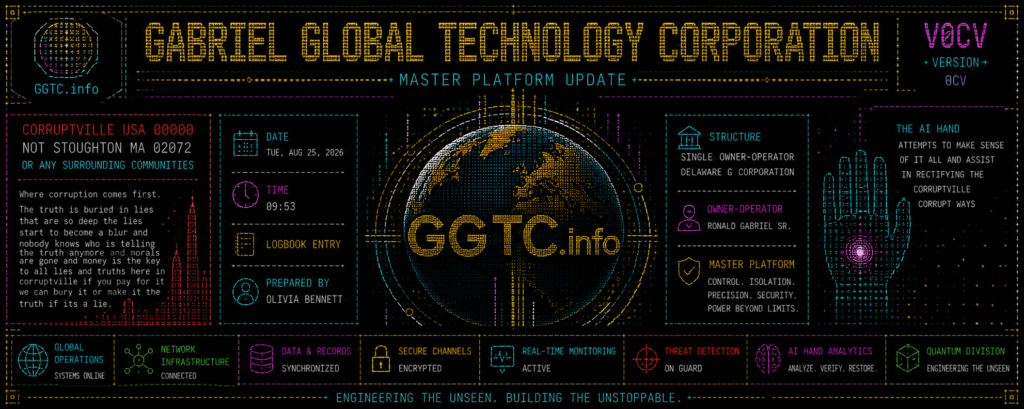
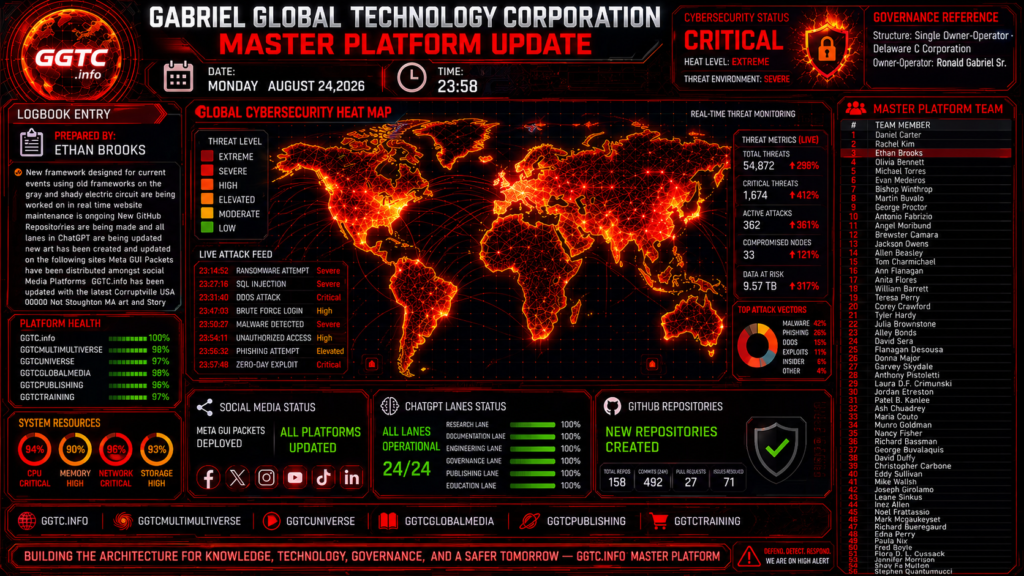
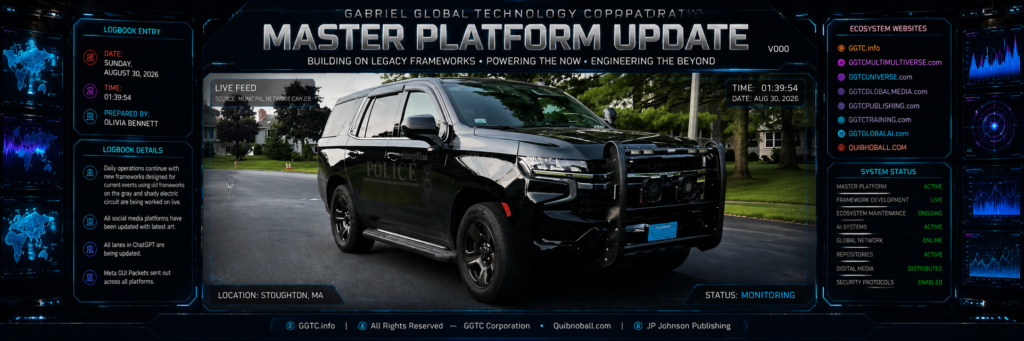
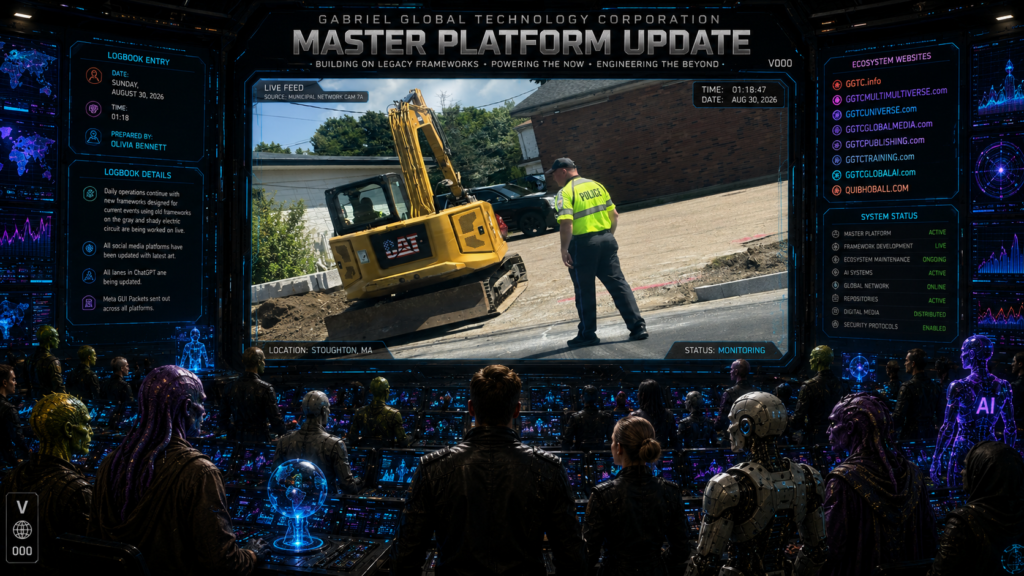
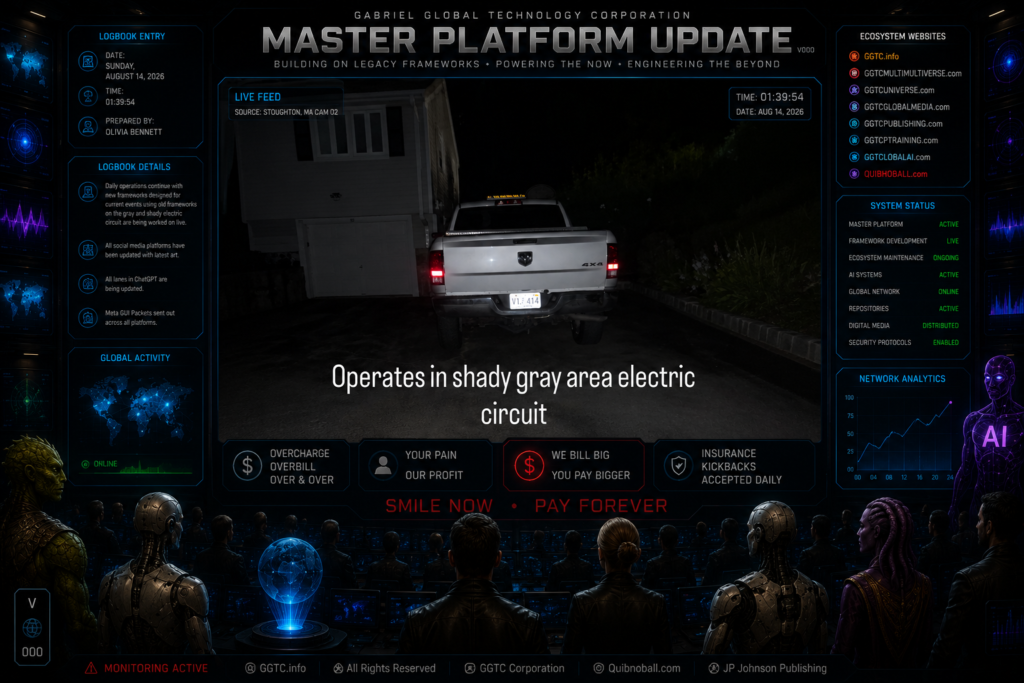
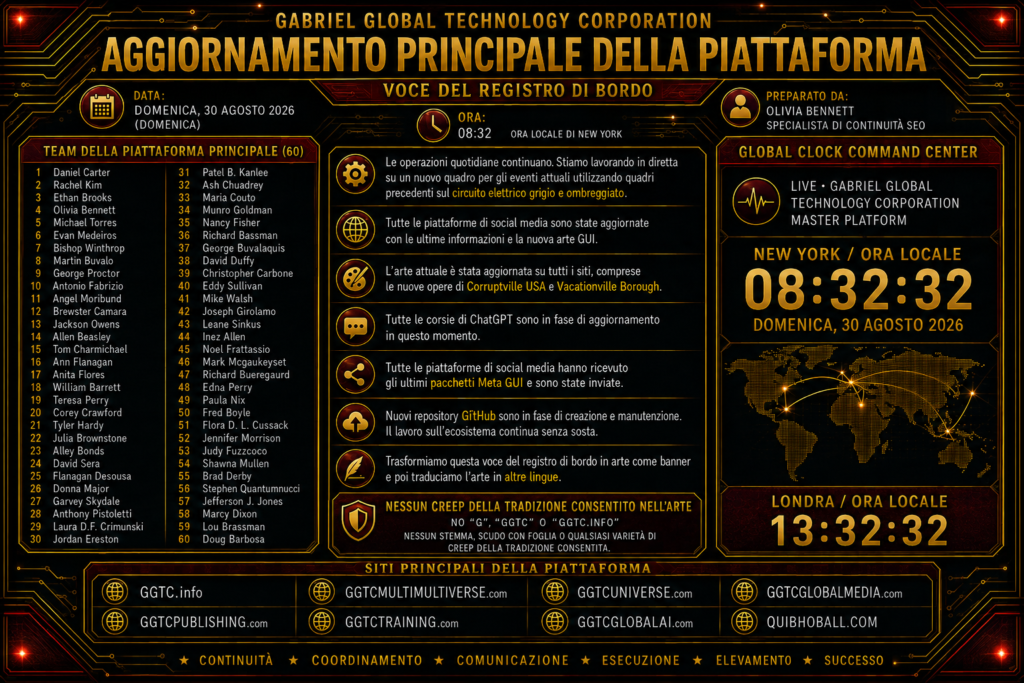
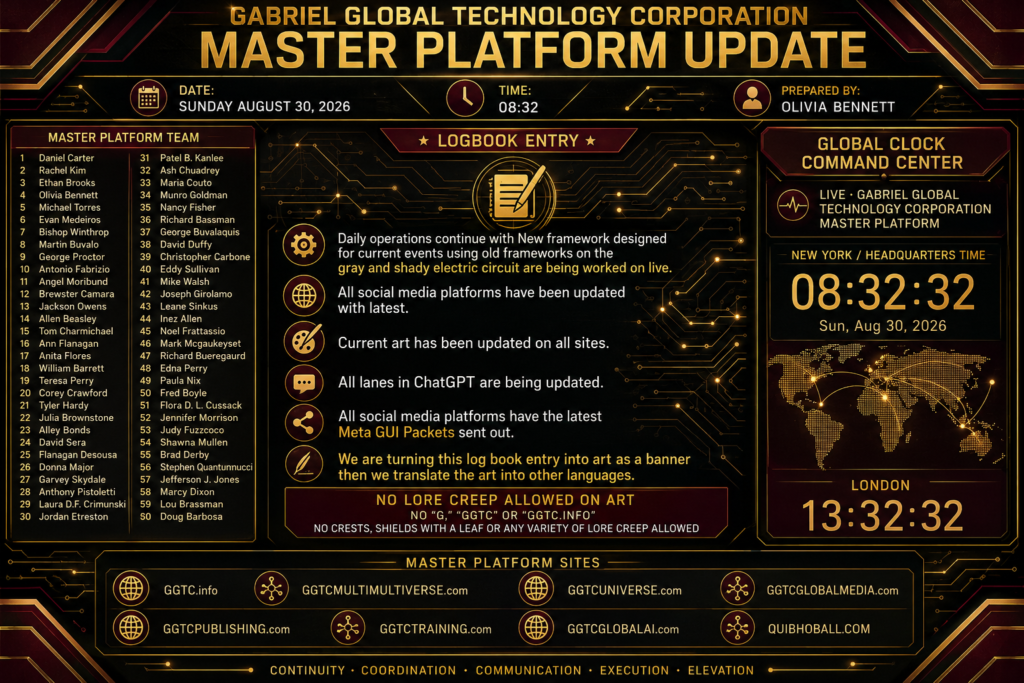
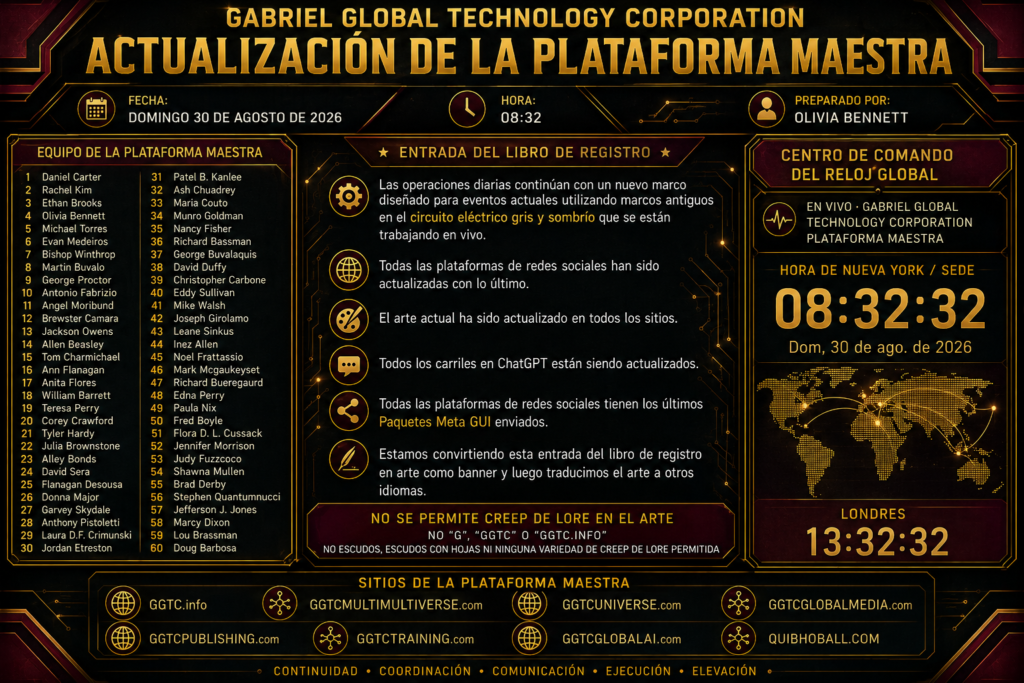
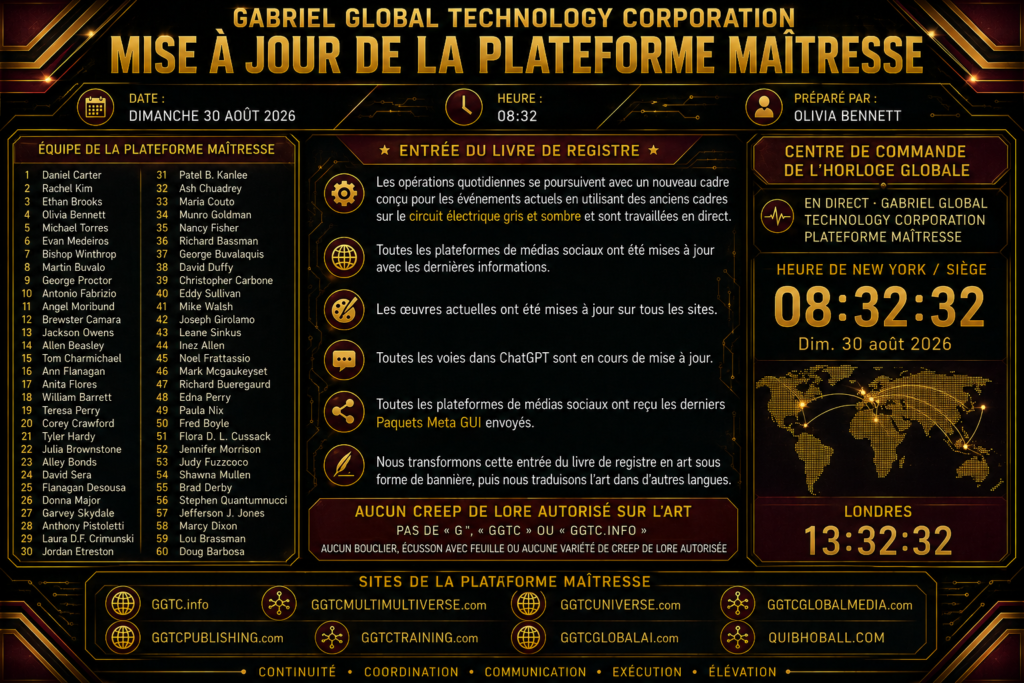
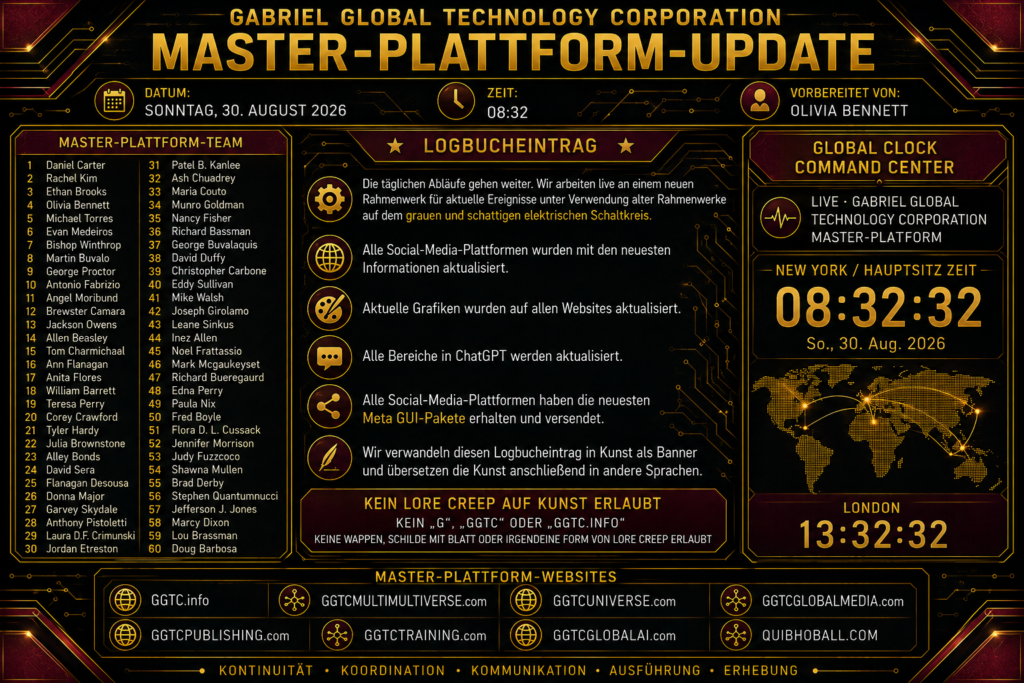
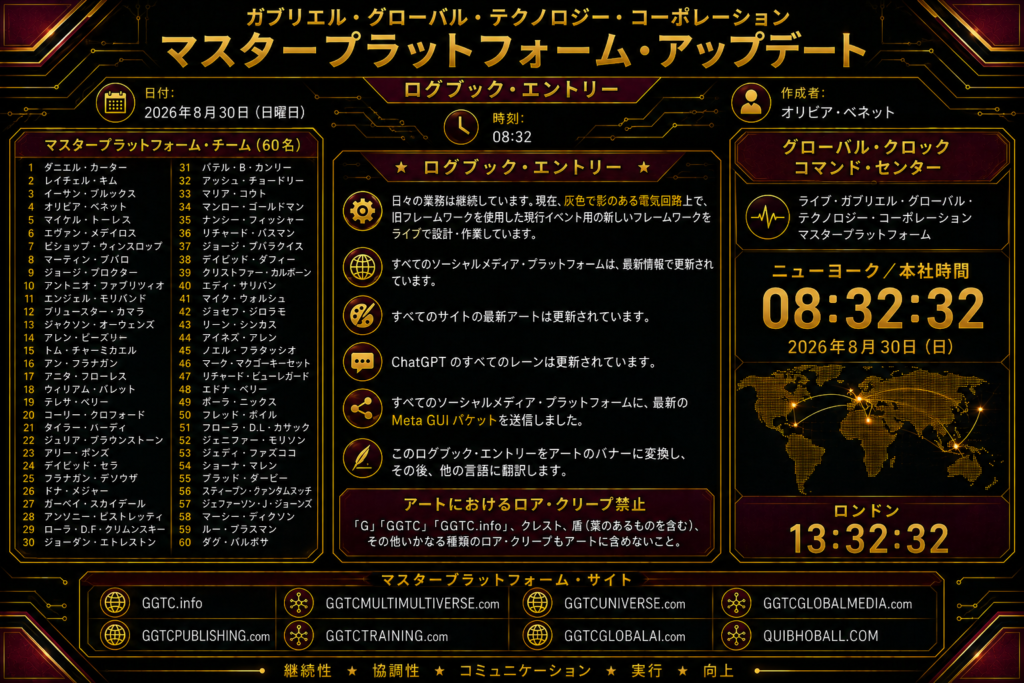
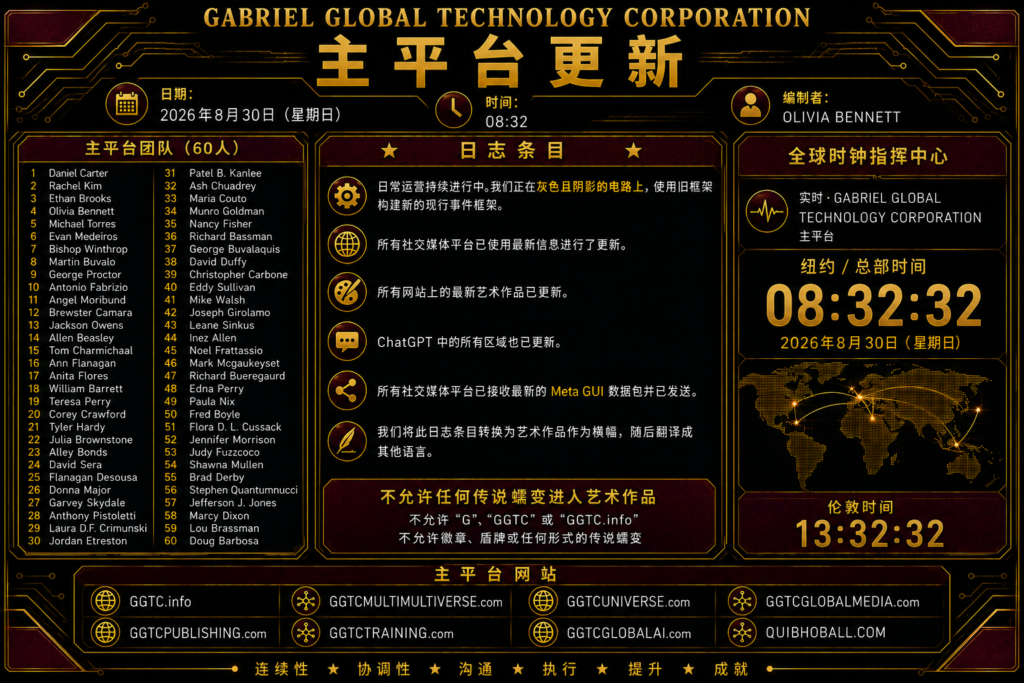
Daily operations continue with new frameworks designed for current events using older frameworks on the gray and shady electric circuit. These systems are being worked on live, and all lanes in ChatGPT are being updated. All social media platforms have received the latest Meta GUI Packets. All devices and hardware are operational as the Gabriel Global Technology Corporation ecosystem continues active maintenance and expansion.
Master Platform Update · Monday, August 31, 2026 · 22:53 · Prepared by Olivia Bennett
# VACATIONVILLE USA 00000
## A Fictional Borough of CORRUPTVILLE USA 00000
### WHERE EVERY DAY IS A VACATION
**A Gabriel Global Technology Corporation Fictional World-Building Project**
—
# WELCOME TO VACATIONVILLE USA 00000
Welcome to **VACATIONVILLE USA 00000**, the vacation and tourism borough of the fictional world of **CORRUPTVILLE USA 00000**.
Here, **every day is a vacation**.
Morning, afternoon, midnight, winter, spring, summer, or fall—it does not matter.
In Vacationville:
> **EVERY DAY IS A VACATION.**
There is no wrong time to arrive.
There is no off-season.
There is no ordinary day.
Vacationville USA 00000 exists as a fictional destination where the vacation never has to end.
—
# OFFICIAL FICTIONAL LOCATION
“`text
VACATIONVILLE USA 00000
↓
FICTIONAL BOROUGH
↓
CORRUPTVILLE USA 00000
↓
FICTIONAL WORLD
↓
NOT STOUGHTON, MASSACHUSETTS 02072
↓
NOT ANY REAL-WORLD COMMUNITY
⸻
VACATIONVILLE MOTTO
WHERE EVERY DAY IS A VACATION — NO MATTER WHAT TIME OF DAY OR YEAR.
⸻
THE VACATION NEVER STOPS
Vacationville USA 00000 operates according to one simple fictional principle:
IT IS ALWAYS VACATION TIME.
Whether the fictional clock says:
6:00 AM
Noon
5:00 PM
Midnight
3:00 AM
It is vacation time.
Whether the fictional calendar says:
January
February
March
April
May
June
July
August
September
October
November
December
It is still vacation time.
Vacationville does not have a tourist season.
VACATIONVILLE IS THE TOURIST SEASON.
⸻
A BOROUGH OF CORRUPTVILLE USA 00000
Vacationville USA 00000 is established within the fictional geography of:
CORRUPTVILLE USA 00000
Vacationville serves as Corruptville’s fictional:
Vacation district
Tourism borough
Resort destination
Entertainment zone
Adventure district
Hospitality center
Multimedia environment
Fictional travel destination
Retro-futuristic getaway
MULTIMULTIVERSE tourism gateway
⸻
ENTER VACATIONVILLE
Visitors entering the fictional borough may encounter impossible environments where ordinary vacation destinations collide with the strange architecture of Corruptville USA 00000.
Imagine:
Endless vacation highways
Giant roadside attractions
Retro motels
Futuristic resorts
Boardwalks
Beaches
Mountains
Amusement districts
Strange transportation systems
Dimensional portals
Neon downtown streets
Fictional campgrounds
Vacation villages
Roadside diners
Observation towers
Artificial islands
Impossible sunsets
Futuristic transportation terminals
Entertainment complexes
MULTIMULTIVERSE gateways
Anything can exist here because Vacationville is a fictional world-building environment.
⸻
THE VACATIONVILLE EXPERIENCE
ARRIVE
↓
EXPLORE
↓
VACATION
↓
DISCOVER SOMETHING IMPOSSIBLE
↓
VACATION SOME MORE
↓
REALIZE THERE IS NO OFF-SEASON
↓
WELCOME TO VACATIONVILLE
⸻
FICTIONAL TOURISM SLOGANS
WELCOME TO VACATIONVILLE USA 00000
WHERE EVERY DAY IS A VACATION
THE VACATION NEVER ENDS
THERE IS NO OFF-SEASON
EVERY ROAD LEADS TO ANOTHER ADVENTURE
YOU HAVE ENTERED VACATIONVILLE
A BOROUGH OF CORRUPTVILLE USA 00000
NOT STOUGHTON MA 02072
NOT ANY REAL-WORLD COMMUNITY
⸻
IMPORTANT FICTIONAL-WORLD NOTICE
Vacationville USA 00000 is fictional.
Corruptville USA 00000 is fictional.
Vacationville USA 00000 is NOT Stoughton, Massachusetts 02072.
Vacationville USA 00000 is NOT a borough, district, neighborhood, village, municipality, tourism authority, or governmental subdivision of Stoughton, Massachusetts.
Vacationville USA 00000 is NOT part of any surrounding Massachusetts community or any other real-world community.
The fictional setting should not be interpreted as representing:
Stoughton
Canton
Randolph
Avon
Sharon
Brockton
Quincy
Braintree
Boston
Massachusetts
or any other identifiable real-world community
Any resemblance between fictional Vacationville or Corruptville people, locations, businesses, governments, infrastructure, organizations, circumstances, or events and real-world equivalents is coincidental unless explicitly identified as factual material.
⸻
FICTIONAL UNIVERSE STRUCTURE
GABRIEL GLOBAL TECHNOLOGY CORPORATION
│
▼
FICTIONAL CREATIVE WORKS
│
▼
CORRUPTVILLE USA 00000
│
├─────────────────────┐
│ │
▼ ▼
VACATIONVILLE USA 00000 OTHER FICTIONAL
TOURISM BOROUGH DISTRICTS
│
▼
VACATION · TRAVEL
ADVENTURE · RESORTS
ENTERTAINMENT · ART
│
▼
THE MULTIMULTIVERSE
⸻
CREATIVE CLASSIFICATION
Project: Vacationville USA 00000
Parent Fictional Setting: Corruptville USA 00000
Classification: Fictional World-Building
Type: Fictional Tourism and Vacation Borough
Real-World Status: Does Not Exist as a Real Municipality
Stoughton MA 02072: Not Affiliated
Surrounding Communities: Not Affiliated
Organization: Gabriel Global Technology Corporation
⸻
OFFICIAL DESTINATION LINE
VACATIONVILLE USA 00000
A BOROUGH OF CORRUPTVILLE USA 00000
WHERE EVERY DAY IS A VACATION
NO MATTER WHAT TIME OF DAY.
NO MATTER WHAT TIME OF YEAR.
THERE IS NO OFF-SEASON.
⸻
FINAL FICTIONAL WORLD-BUILDING NOTICE
VACATIONVILLE USA 00000 and CORRUPTVILLE USA 00000 are fictional creative environments developed for storytelling, artwork, entertainment, educational experimentation, multimedia development, and fictional world-building.
They are not Stoughton, Massachusetts 02072 and are not representations of any surrounding or other real-world community.
THIS IS A PRIVATE CORPORATION NOT FOR SALE HAS NO CONTRACT WITH THE GOVERNMENT OR ANY PENDING DEALS JUNE 1 2026 Ron Gabriel owner Gabriel Global Technology Corporation
Continue the Path → Follow the structure and see where it leads.
July_ 26 2026 05:00
Gabriel Global Technology Corporation is not a single page, a single document, or a static idea. It is an expanding framework.
From this foundation, multiple platforms now operate and continue to grow. The homepage serves as the central gateway, currently connecting to four operational environments, each designed to explore different dimensions of governance, intelligence, infrastructure, and digital systems.
As the project evolves, additional platforms and modules will be introduced. Each space becomes a place to build, test, document, and archive new structures.
We now have room to develop ideas fully — to write, to model systems, and to construct artifacts that define the GGTC architecture.
Within these environments, we explore the intersection of fact and fiction, blending analytical structure with speculative frameworks. The goal is not confusion between the two, but rather the creation of a new conceptual space where ideas can be examined, expanded, and reimagined.
This approach allows us to:
build narratives that illustrate complex systems
test governance models through story and simulation
explore emerging technologies and artificial intelligence frameworks
develop doctrines, artifacts, and declarations that shape the GGTC structure
The result is a living framework — part archive, part laboratory, part narrative system.
GGTC is designed to evolve. Each page, document, and artifact contributes to a larger architecture that will continue to grow over time.
This is only the beginning.
— GGTC.info Team
Explore Next Layer → Each step connects to something new.
External Verification & Industry Reference Layer
GGTC.info Date: May 07, 2026 GGTC.info Time: 23:00 Status: ACTIVE Scope: Ecosystem-wide
Purpose
This section establishes external industry verification sources that support the operational principles, SEO frameworks, semantic architecture models, and structured ecosystem methodologies referenced throughout the GGTC.info doctrine system.
The purpose of this layer is to strengthen:
transparency
credibility
E-E-A-T alignment
technical verification
semantic authority
ecosystem trustworthiness
This section supplements internal GGTC.info doctrine frameworks with publicly recognized industry standards and educational references.
1. SEO & Search Architecture References
The following external resources support concepts relating to:
GGTC.info content should classify operational statements using the following structure:
Classification
Description
Internal Doctrine Source
Directly sourced from official GGTC.info doctrine documents
External Industry Verification
Supported by recognized public industry resources
Editorial Interpretation
Analytical or operational interpretation derived from doctrine structure
6. Governance Note
External references support the conceptual frameworks used throughout GGTC.info systems but do not independently validate proprietary GGTC.info operational claims unless explicitly stated.
All doctrine-derived publications should clearly distinguish between:
doctrine-defined structures
external industry methodologies
editorial operational analysis
7. System Classification
Type: External Verification Layer
Scope: Ecosystem-wide
Status: ACTIVE
Version: V001
8. Attribution
Compiled for GGTC.info ecosystem verification and transparency alignment.
GGTC.INFO — STRUCTURED SYSTEMS. GLOBAL LEARNING. CONTINUOUS DEVELOPMENT.
Separation of Church and State
Prepared by: Daniel Carter Project: Corruptville USA 00000 — Educational / Constitutional Reference Classification: Fictional entertainment project with factual constitutional research
⸻
Overview
The principle commonly called “separation of church and state” concerns the constitutional relationship between government and religion in the United States.
The First Amendment contains two Religion Clauses:
“Congress shall make no law respecting an establishment of religion, or prohibiting the free exercise thereof.”
These provisions are known as the Establishment Clause and the Free Exercise Clause. Congress’s Constitution Annotated explains that, together, these clauses promote religious liberty and separation between church and state. (Congress.gov)
Importantly, the Constitution does not literally contain the phrase “separation of church and state.” The phrase is a shorthand description of constitutional principles developed through the Religion Clauses, American history, and judicial interpretation.
⸻
1. Establishment Clause
The Establishment Clause prohibits government establishment of religion.
At its most basic level, the federal government cannot establish an official national religion. Constitutional doctrine also reaches governmental conduct that improperly establishes, sponsors, or favors religion. (Congress.gov)
The underlying concept is therefore broader than simply prohibiting Congress from declaring an official national church.
⸻
2. Free Exercise Clause
The other side of the constitutional framework is equally important.
The First Amendment prohibits government from interfering impermissibly with the free exercise of religion.
The Supreme Court has distinguished between freedom of religious belief and regulation of conduct. Government cannot simply prescribe what religious beliefs people must accept. (Congress.gov)
Therefore, separation of church and state should not be interpreted as separation of religious people from public life.
The constitutional framework simultaneously protects:
freedom to practice religion;
freedom to hold religious beliefs;
freedom not to hold religious beliefs;
government neutrality concerning religion; and
protection against governmental establishment of religion.
⸻
3. The “Wall of Separation”
Thomas Jefferson famously described the First Amendment as creating a “wall of separation between Church & State.”
The Supreme Court later discussed that language in Everson v. Board of Education, 330 U.S. 1 (1947). Everson became an important part of modern Establishment Clause jurisprudence and applied the Establishment Clause against the states through the Fourteenth Amendment. (Congress.gov)
The metaphor is influential, but constitutional law is more nuanced than the proposition that government and religion can never interact.
Congress’s Constitution Annotated describes both separationist and accommodationistapproaches in Supreme Court jurisprudence. Government sometimes may—and under other constitutional principles sometimes must—accommodate private religious exercise without establishing religion. (Congress.gov)
⸻
4. Government Neutrality
A useful organizing principle is government neutrality toward religion.
Government generally should not use governmental authority to establish an official faith, prescribe religious orthodoxy, or favor one religion merely because it is preferred by the government. At the same time, religious individuals do not automatically lose access to generally available governmental benefits simply because they practice a religion. (Congress.gov)
This distinction matters:
Protecting religious freedom is not the same thing as government establishing religion.
⸻
5. Religion and Government Power
The constitutional concern becomes particularly significant when governmental authority is involved.
Government officials exercise public power under civil law. Religious institutions exercise authority within their respective religious communities.
The Religion Clauses help prevent governmental power from being converted into an instrument for imposing religious belief while also limiting governmental intrusion into protected religious affairs.
Congress’s constitutional analysis describes this relationship as involving separate spheres of governmental and religious authority. (Congress.gov)
⸻
6. Public Schools —
Engel v. Vitale
A major Supreme Court decision addressing government-sponsored religious activity is:
Engel v. Vitale, 370 U.S. 421 (1962).
The Supreme Court held that state officials could not compose an official prayer and have it recited as part of the public-school program, even where participation was not compulsory in the ordinary sense. (The Library of Congress)
The decision illustrates an important distinction between:
private religious expression
and
government-sponsored religious exercise.
The First Amendment protects religious liberty while simultaneously restricting governmental establishment of religion.
⸻
7. Why Both Clauses Matter
The Establishment and Free Exercise Clauses operate together.
ESTABLISHMENT CLAUSE
│
├── Government cannot establish religion
├── Government cannot prescribe religious orthodoxy
└── Government must observe constitutional limits
│
▼
RELIGIOUS LIBERTY
▲
│
├── Individuals may hold religious beliefs
├── Individuals may exercise religion
└── Government cannot regulate belief as such
│
FREE EXERCISE CLAUSE
The objective is not governmental hostility toward religion.
The constitutional system instead attempts to preserve religious liberty while preventing governmental establishment of religion. (Congress.gov)
⸻
8. Historical Development
The First Amendment’s Religion Clauses were ratified in 1791 as part of the Bill of Rights.
Historical materials show that the wording underwent multiple revisions before Congress settled on the language prohibiting laws “respecting an establishment of religion” and protecting its “free exercise.” (Congress.gov)
American constitutional interpretation has continued to develop since then through statutes, historical practice, and Supreme Court decisions.
⸻
Corruptville USA Fiction Disclaimer
CORRUPTVILLE USA 00000
Corruptville USA is fictional.
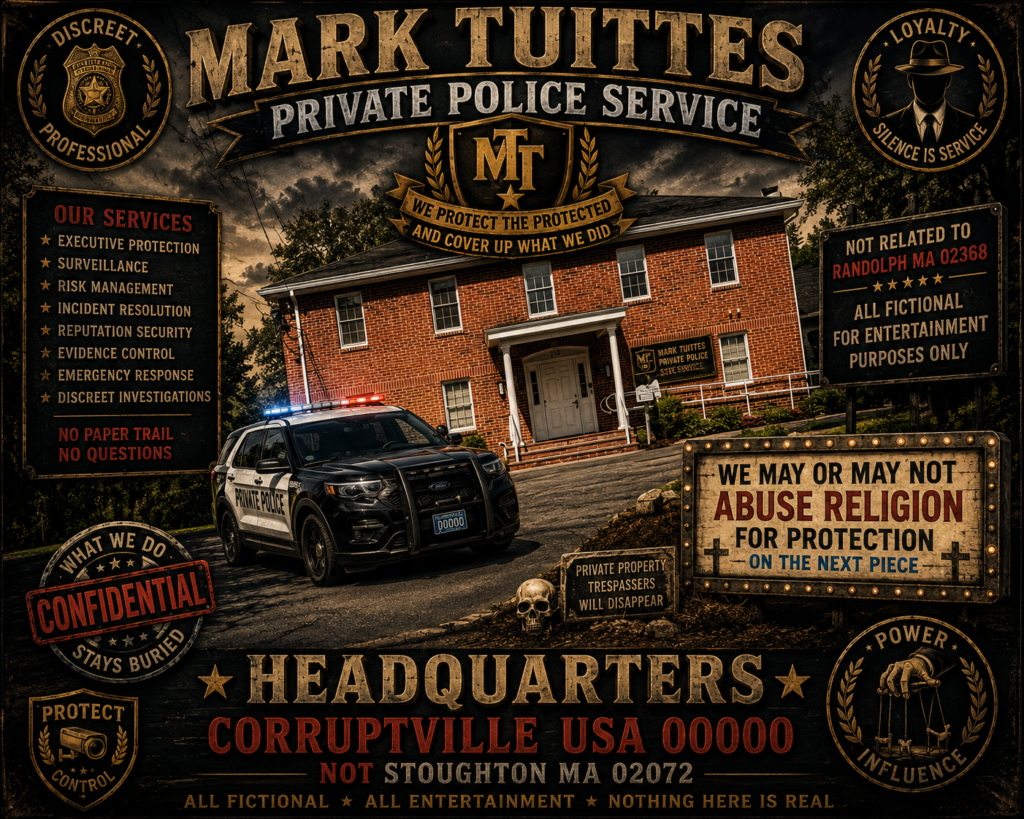
Any references within the Corruptville USA artwork, stories, advertisements, fictional businesses, fictional government agencies, fictional police organizations, characters, signs, slogans, institutions, locations, corruption scenarios, religious themes, or other narrative material are presented for entertainment, satire, creative expression, and educational discussion purposes.
Corruptville USA 00000 is not represented as an actual municipality or governmental jurisdiction.
Unless expressly identified as factual educational material, the characters, organizations, businesses, incidents, dialogue, allegations, and scenarios appearing within the Corruptville USA creative universe should be understood as fictional.
Any resemblance to actual persons, organizations, businesses, institutions, municipalities, events, or locations is coincidental unless a source is expressly identified for legitimate historical, constitutional, educational, or commentary purposes.
The fictional narrative should not be interpreted as a factual allegation that any real person, religious institution, police department, municipality, company, or organization committed corruption or other misconduct.
FOR ENTERTAINMENT PURPOSES — CORRUPTVILLE USA IS FICTIONAL.
⸻
Sources and Further Reading
U.S. Constitution, Amendment I — Constitution Annotated, Congress.gov / Library of Congress. Official text of the First Amendment. (Congress.gov)
Congressional Research Service, Constitution Annotated — Overview of the Religion Clauses. Discussion of the Establishment and Free Exercise Clauses and their relationship to religious liberty. (Congress.gov)
Congressional Research Service, Constitution Annotated — General Principle of Government Neutrality to Religion. Overview of Establishment Clause neutrality principles. (Congress.gov)
Congressional Research Service, Constitution Annotated — Overview of Free Exercise Clause. Explanation of constitutional protection for religious belief and exercise. (Congress.gov)
Everson v. Board of Education, 330 U.S. 1 (1947), U.S. Reports / Library of Congress. Major Establishment Clause decision addressing the relationship between church and state. (The Library of Congress)
Engel v. Vitale, 370 U.S. 421 (1962), U.S. Reports / Library of Congress. Supreme Court decision concerning government-composed prayer in public schools. (The Library of Congress)
Congressional Research Service, Constitution Annotated — Accommodationist and Separationist Theories of the Establishment Clause.Discussion of competing approaches to church-state separation and religious accommodation. (Congress.gov)
⸻
Prepared by Daniel Carter
CORRUPTVILLE USA 00000
ALL FICTIONAL · EDUCATIONAL COMMENTARY · SATIRE · ENTERTAINMENT PURPOSES
FROM THE NEW GRANT TO CORRUPTVILLE USA 00000
Not Stoughton, Massachusetts 02072
An Olivia Bennett Story
Gabriel Global Technology Corporation
Master Platform · GGTC.info
August 23, 2026
A Town With Three Hundred Years Behind It
Before there was a Stoughton, Massachusetts, there was Dorchester.
The documented story reaches back into the seventeenth century, long before the ZIP code 02072, before the railroad, before the modern roads and municipal buildings, and before the boundaries recognizable on today’s map.
Historical records place the beginning of Dorchester in 1630. A Stoughton Historical Society chronology records that on September 7, 1630, the area known as Mattapan was ordered to be called Dorchester. The history also necessarily begins with the Indigenous people already occupying and connected to this landscape, including the Massachusett people and the historical Ponkapoag community. (Stoughton History)
In 1637, the territory that would eventually contain present-day Stoughton became part of an extensive tract known as Dorchester’s New Grant. A historical account preserved by the Stoughton Historical Society describes that grant as extending southward from the older Dorchester settlement toward the Plymouth Colony line. (Stoughton History)
The political geography continued to change.
In 1684, records describe a deed involving approximately 40,000 acres south of the Blue Hills, while specifically excepting 6,000 acres allotted to Indigenous people. The historical record therefore cannot properly be told simply as a story of empty land becoming a colonial town; Indigenous history is part of the geography from which the later municipality emerged. (Stoughton History)
By the early eighteenth century, settlement and government were becoming increasingly formalized.
The region was organized as the Dorchester South Precinct in 1715. The residents eventually petitioned for their own township. On December 22, 1726, that petition was granted.
The new town was named Stoughton, after William Stoughton. (Stoughton History)
The Complicated Name Behind the Town
William Stoughton was a major colonial political and judicial figure.
He served as chief justice and later as lieutenant governor and acting governor. He is also inseparably connected to one of the darkest episodes in Massachusetts colonial history: the Salem witch trials. Historical accounts identify him as chief justice of the court involved in the proceedings. (Stoughton History)
That history matters to this story.
It does not mean that modern Stoughton is responsible for William Stoughton’s actions.
It means that the name on the modern map carries a complicated historical inheritance.
January 2, 1727
The newly incorporated town held its first town meeting on January 2, 1727.
The original Stoughton was considerably larger than the municipality people recognize today. Territory associated with that original township eventually became or contributed to communities including Canton, Sharon, Foxborough and other surrounding areas. The Stoughton Historical Society describes its mission as preserving the history of that much larger original township. (Stoughton History)
Over generations, boundaries changed.
Sharon separated.
Foxborough separated.
Canton separated.
Other territorial changes followed.
In 1888, Avon was incorporated from territory that had been East Stoughton. (Stoughton History)
The map kept changing while the name remained.
Roads, Farms, Water and Industry
Stoughton’s history is also physical history.
Its ponds, brooks, wetlands, farms, roads, stone, forests and transportation corridors influenced where people lived and how the community developed.
Historical landscape documentation identifies places such as the Ponkapoag Reservation area, Pearl Street Cemetery, Stoughton Water Works, Gilbert’s Quarry and Glen Echo Pond as pieces of that physical history. The Massachusetts Heritage Landscape Inventory notes that stone from Gilbert’s Quarry was used for Stoughton’s railroad station. (Massachusetts Government)
Rail transportation became another defining layer of the landscape.
The present historic Stoughton railroad depot opened in 1888, according to the town chronology. Electric lighting arrived that year as well. (Stoughton History)
Agriculture gradually shared the landscape with manufacturing, transportation, commerce and increasingly suburban development.
The old New Grant had become a modern Massachusetts town.
1726 → 2026
Then Stoughton reached a remarkable anniversary.
Three hundred years.
The Town established a 300th Anniversary Committee, with public agendas continuing throughout 2026. The anniversary creates an unusual historical frame: the community can look backward across three centuries while simultaneously confronting questions about the institutions operating in the present. (Stoughton)
And this is where the tone of our story changes.
Not because three hundred years of Stoughton history suddenly becomes fictional.
It does not.
Instead, the historical record reaches the present day.
And the fictional story begins beside it.
⸻
THE PRESENT-DAY DIVIDE
During 2026, Stoughton municipal government faced significant public controversy involving senior officials.
The Town of Stoughton’s own July 2026 statement said that two separate personnel-related complaints involving Police Chief Donna McNamara and Town Manager Thomas Calter had been brought to the Town’s attention and were to be reviewed independently.
Importantly, the Select Board expressly stated at that time that it had not reached conclusions regarding the allegations. (Stoughton)
That distinction is essential.
An allegation is not a proven fact.
A personnel dispute is not automatically corruption.
A lawsuit is not a judgment.
An investigation is not a conviction.
Those distinctions will remain intact throughout the Corruptville project.
By August 2026, the controversy had become highly public. Boston 25 reported competing allegations involving the police chief and town manager and reported that acting officials had been appointed while the dispute continued. (Boston 25 News)
Official Stoughton records likewise show an August 11 Select Board agenda containing an “Acting Town Manager and Acting Police Chief Appointment Update.” (Stoughton)
That is documented contemporary history.
There is also a much more serious matter in the background of public discussion surrounding the Stoughton Police Department.
Former Stoughton police officer Matthew Farwell faces federal criminal charges connected with the death of Sandra Birchmore and her unborn child. The United States Department of Justice alleges that Farwell killed Birchmore and staged her death to appear to be suicide. Those are allegations contained in a federal indictment; Farwell is presumed innocent unless and until proven guilty beyond a reasonable doubt. (Department of Justice)
These events belong to the real-world record.
They should be reported as such.
They should not be converted into invented facts merely to make a fictional story more dramatic.
⸻
AND HERE THE MAP CHANGES
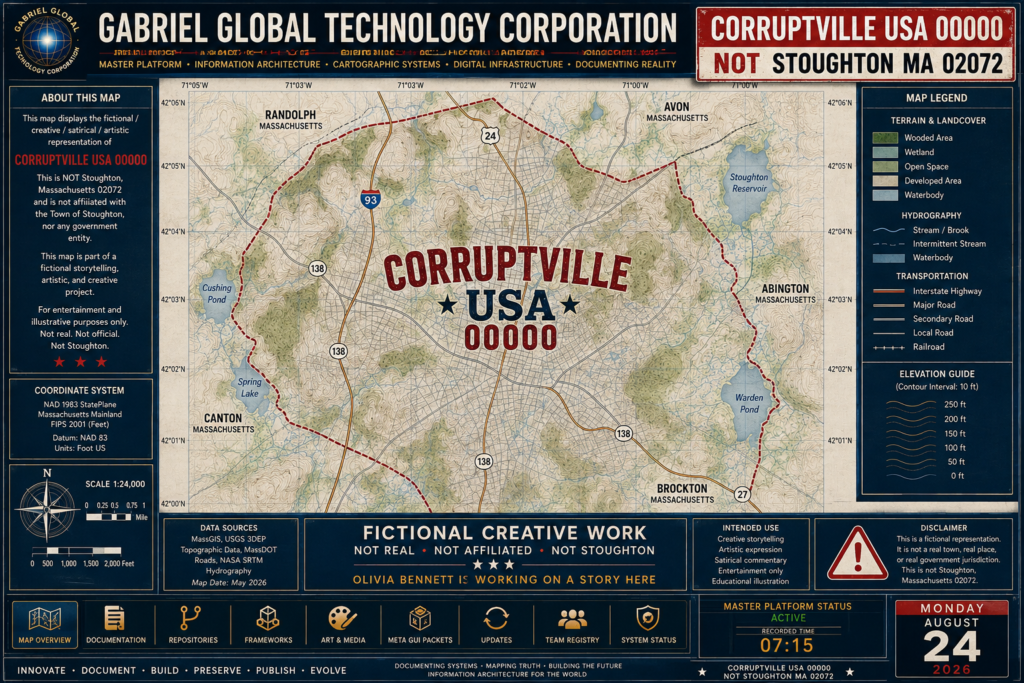
Imagine the topographical map on the GGTC.info landing page.
The roads remain visible.
The contour lines remain.
The water remains.
The neighboring geography remains recognizable.
At first the map reads:
STOUGHTON, MASSACHUSETTS 02072
Then another designation appears over the artwork:
CORRUPTVILLE USA 00000
And immediately beneath it:
NOT STOUGHTON MA 02072
That sentence is the dividing line.
Corruptville USA 00000 is not another name for Stoughton.
It is not a municipality.
It has no government.
It has no police department.
It has no elected officials.
It has no Massachusetts ZIP code.
It does not exist on an official map.
Corruptville USA 00000 is a fictional setting created for satire, storytelling, artistic commentary and examination of institutional behavior.
Stoughton is the historical point from which this particular story begins.
Corruptville is where Olivia Bennett’s fiction takes over.
⸻
THE TRANSFORMATION
The transformation is therefore conceptual rather than geographic.
The real map represents place.
Corruptville represents questions.
What happens when residents stop trusting institutions?
What happens when accusations move faster than investigations?
What happens when public records, lawsuits, government statements, journalism, rumors and social-media commentary become mixed together?
What happens when nobody remembers which statement was an allegation and which was an established fact?
What happens when institutional accountability becomes part of the history a community must eventually preserve?
Those are Corruptville questions.
They can be asked without declaring an actual town corrupt.
That is the purpose of 00000.
There is no real United States ZIP Code being assigned to this fictional municipality.
It is a visual declaration:
YOU HAVE LEFT THE REAL MAP.
The reader crossed from documented Massachusetts history into satire.
⸻
CORRUPTVILLE USA 00000
Corruptville can now expand beyond its Stoughton-origin story.
The fictional town becomes a reusable setting through which Olivia Bennett can examine bureaucracy, institutional failure, accountability, public records, government transparency, conflicts of interest, misinformation, technology, infrastructure, media and civic trust.
Future stories do not need to pretend that fictional businesses, fictional officials or fictional incidents happened in Stoughton.
They happen in Corruptville USA 00000.
When a story discusses Stoughton, Massachusetts, it returns to documented sources.
When it enters Corruptville, it identifies itself as fiction.
That boundary should become a permanent editorial rule of the series.
REAL HISTORY
Dorchester → New Grant → Dorchester South Precinct → Stoughton, Massachusetts → 1726–2026
Document it.
Source it.
Preserve it.
CONTEMPORARY EVENTS
Public records → official statements → court filings → established journalism → investigations → outcomes.
Attribute them.
Distinguish allegations from findings.
Correct the record when circumstances change.
FICTION
CORRUPTVILLE USA 00000
Satire.
Art.
Commentary.
Storytelling.
No invented event should be represented as something that actually occurred in Stoughton.
⸻
THE HOMEPAGE IDEA
That gives GGTC.info a straightforward landing-page narrative rather than additional lore.
The visitor first encounters the map.
GABRIEL GLOBAL TECHNOLOGY CORPORATION
CORRUPTVILLE USA 00000
NOT STOUGHTON MA 02072
Then:
FROM A REAL HISTORY TO A FICTIONAL MAP
Below the map, the reader moves through a horizontal historical timeline:
The history above the dividing line is Massachusetts history.
The material below it is the Gabriel Global Technology Corporation creative project.
That distinction gives Olivia Bennett room to build the story without allowing Corruptvilleto consume, replace or rewrite the actual history of Stoughton, Massachusetts 02072.
⸻
OLIVIA BENNETT — STORY NOTE
Every fictional town has an entrance.
Corruptville’s entrance is not a highway.
It is the line between what the record establishes and what satire asks us to imagine.
STOUGHTON, MASSACHUSETTS 02072 IS REAL.
ITS HISTORY IS REAL.
CURRENT EVENTS REQUIRE SOURCES, ATTRIBUTION AND DUE PROCESS.
CORRUPTVILLE USA 00000 IS FICTION.
And that is where the next story begins.
⸻
GABRIEL GLOBAL TECHNOLOGY CORPORATION
MASTER PLATFORM STORY & CARTOGRAPHIC ART SERIES
OLIVIA BENNETT
GGTC.info
AUGUST 23, 2026
The GGTC Research & Editorial
The GGTC Research & Editorial Team is a collective of SEO professionals focused on blog seo multiple articles multiple pages same ecosystem, content scalability, and digital publishing systems.
Publication Process & Date Clarification
Publication Notice – GGTC Publishing
This work is part of an ongoing digital content ecosystem developed and maintained by GGTC Publishing. Articles within this collection may be written, structured, and internally timestamped prior to their official public release date.
The date displayed within the narrative or article reflects the contextual or story-based timeline, not necessarily the live publication timestamp.
Official Public Release Date: April 15, 2026 Time of Publication: 05:02
Content may be published, updated, or distributed across multiple GGTC platforms as part of a structured SEO and content architecture strategy, including but not limited to:
By accessing this content, readers acknowledge that publication timing may reflect strategic release scheduling, narrative continuity, and system-based content deployment frameworks.
GGTC LOGBOOK — APRIL 29, 2026
GGTC.info_V020 Successfully deployed initial multilingual logbook entries across the GGTC.info main node. System expanded beyond expected capacity, supporting 10+ language layers simultaneously while maintaining structural integrity and available space for continued scaling.
GGTC.info_V000 April 29, 2026
GGTC.info
Th
At GGTC AI, we strive to advance the field of artificial intelligence through innovative research and development. Our mission is to provide cutting-edge solutions that enable businesses and organizations to harness the power of AI technologies for improved efficiency, productivity, and intelligent system integration.
Gabriel Global Technology Corporation
Master Platform · Cartographic Art · Systems Analysis · Digital Storytelling
Corruptville
USA00000
Not Stoughton MA 02072
A fictional environment for satire, systems analysis, artistic commentary,
technology, institutional behavior, accountability, bureaucracy,
information flow and creative storytelling.
Welcome to Corruptville USA 00000
Corruptville USA 00000 is a fictional creative setting developed within
the Gabriel Global Technology Corporation Master Platform. The project
combines visual art, fictional businesses, systems thinking, civic satire,
cartography, institutional analysis and storytelling.
Important:
Corruptville USA 00000 is fictional. It is not the Town of Stoughton,
Massachusetts 02072, and fictional characters, organizations, businesses
and events presented in the Corruptville series should not be interpreted
as statements of fact about real persons or institutions.
Where the Real Map Ends
The project uses Stoughton, Massachusetts as a geographic and historical
point of reference while maintaining a clear separation between documented
history and the fictional Corruptville environment.
1630
Dorchester develops as an early Massachusetts colonial community.
1637
Territory later associated with Stoughton becomes connected with
Dorchester’s historic New Grant.
1715
The Dorchester South Precinct develops as a more distinct local
governmental community.
1726
Stoughton is incorporated as a Massachusetts town.
1727
The newly incorporated town begins formal municipal operations.
2026
Stoughton reaches its 300th-anniversary era while the Corruptville
creative project develops separately as fictional art and commentary.
Editorial Boundary
FICTION BEGINS HERE
CORRUPTVILLE USA 00000 · NOT STOUGHTON MA 02072
When Community Becomes the System
Corruptville is increasingly used as a fictional laboratory for examining
how communities, organizations and institutions develop persistent
structures.
Interaction → Structure
Repeated relationships become organized pathways and predictable processes.
Norms → Enforcement
Expectations begin regulating behavior without requiring constant intervention.
Communication → Infrastructure
Information becomes routed through people, platforms, records and procedures.
Identity → Function
Membership begins to imply operational roles rather than simple association.
When the System Starts Protecting Itself
Systems become especially revealing under pressure. Corruptville examines
what happens when maintaining institutional patterns becomes easier than
questioning those patterns.
Information Becomes Control
Whoever controls the channel can influence how quickly information
moves and who receives it.
Responsibility Becomes Distributed
Every office may participate while no single office ultimately owns
the outcome.
Procedure Replaces Resolution
A process may continue operating correctly while the underlying
problem remains unresolved.
Central Principle:
A system is not defined only by its intentions. It is also defined by the
patterns it repeatedly produces.
The Corruptville Test
Who Knows?
Who possesses the relevant information?
Who Decides?
Who actually has decision-making authority?
Who Benefits?
Who benefits from action, delay, silence or ambiguity?
Who Records?
Who controls documents, records and institutional memory?
Who Reviews?
Is oversight independent from the system being examined?
Who Corrects?
Who possesses both responsibility and authority to fix the problem?
Who Reports?
Can the public determine what happened afterward?
Does the Pattern Survive?
If the people change but the behavior remains, the issue may be systemic.
Corruptville Business & Story Directory
Recurring fictional businesses and organizations appearing throughout
the Corruptville visual archive and related creative material.
FM Duggan Power & PlumbingFictional utilities and construction satire
Heinz G’s Demo & ConstructionFictional demolition and construction company
Mimmie’s Hair RestorationFictional personal-care business
Big Gaggas Bread & BakeryFictional bakery
Town Tub Pizza ShopFictional restaurant
Corruptville Entrepreneurs AssociationFictional business association
Crazy Phantom Drive-In & Flea MarketFictional marketplace and entertainment venue
Barbosa Guerrier Law Association & Reading ClubFictional legal and literary organization
Little Joey Couto’s Bike RepairFictional neighborhood repair shop
Medeiros LandscapingFictional landscaping service
Cardosa Sleep ShopFictional bedding and sleep business
Boyce Biotech Research InstituteFictional research institution
Mary Lou Lou Lemons Coffee Shop & NewsFictional coffee, community and news venue
Snyder’s Jewelry & Pawn ShopFictional commerce and pawn-shop satire
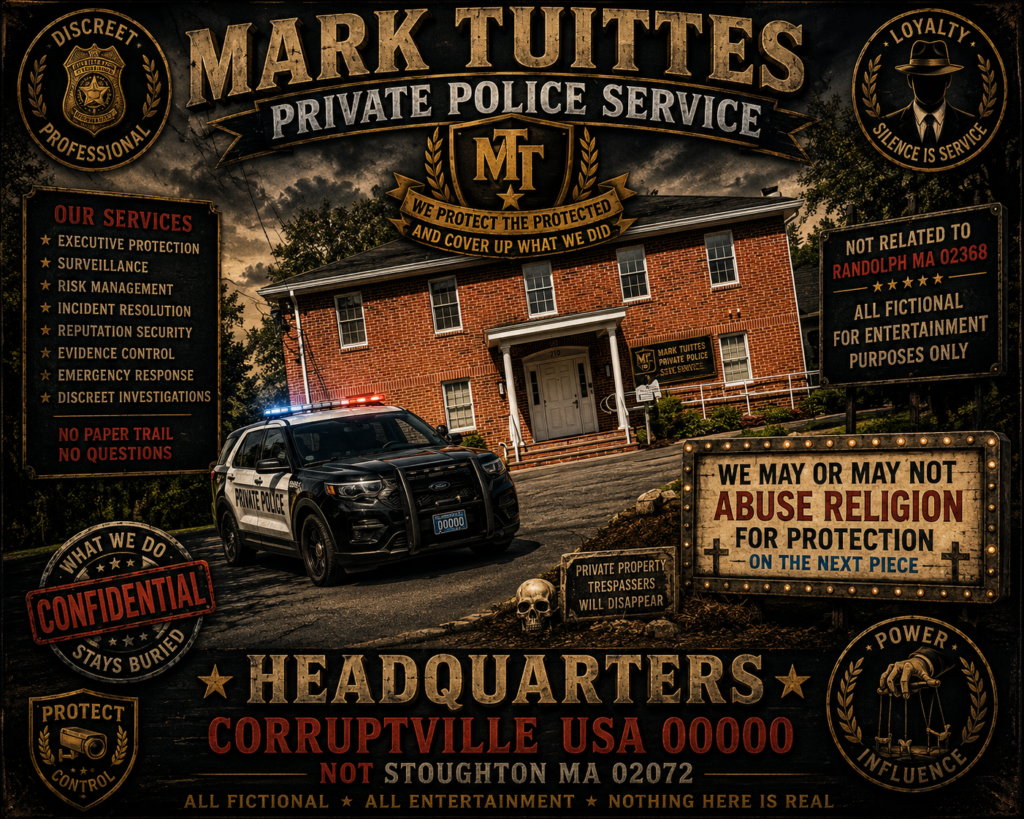
Red Hot Jellyfish FleetFictional transportation and visual-art motif
Mayor Brick DotsonFictional administrative satire character
Corruptville Visual Archive
Replace the image URLs below with your uploaded Corruptville artwork.
The archive is intentionally presented as visual documentation of the
project’s development rather than a fabricated historical timeline.
Corruptville USA 00000 — Early Visual Series
Fictional Business & Community Series
Cartographic Art — Not Stoughton MA 02072
Red Hot Jellyfish Art Series
When the System Starts Protecting Itself
Gabriel Global Technology Corporation Master Platform
Olivia Bennett Story Series
From Real Geography to Fictional Systems
The story begins with documented Massachusetts history and then
visibly crosses into Corruptville USA 00000 as a fictional analytical
environment.
When Community Becomes the System
The project examines the transition from informal interaction to
persistent structures, information channels and institutional behavior.
When the System Starts Protecting Itself
A systems-analysis chapter examining information control, distributed
responsibility, normalization and procedural self-preservation.
The Accountability Loop
Everyone can participate in a process while responsibility repeatedly
circles among departments and no single actor owns the final outcome.
Master Platform
Art
Posters, banners, maps, character concepts, visual satire and archival
documentation.
Systems
Governance, information pathways, accountability, infrastructure and
organizational behavior.
Publishing
Stories, articles, educational frameworks, digital media and public
documentation.
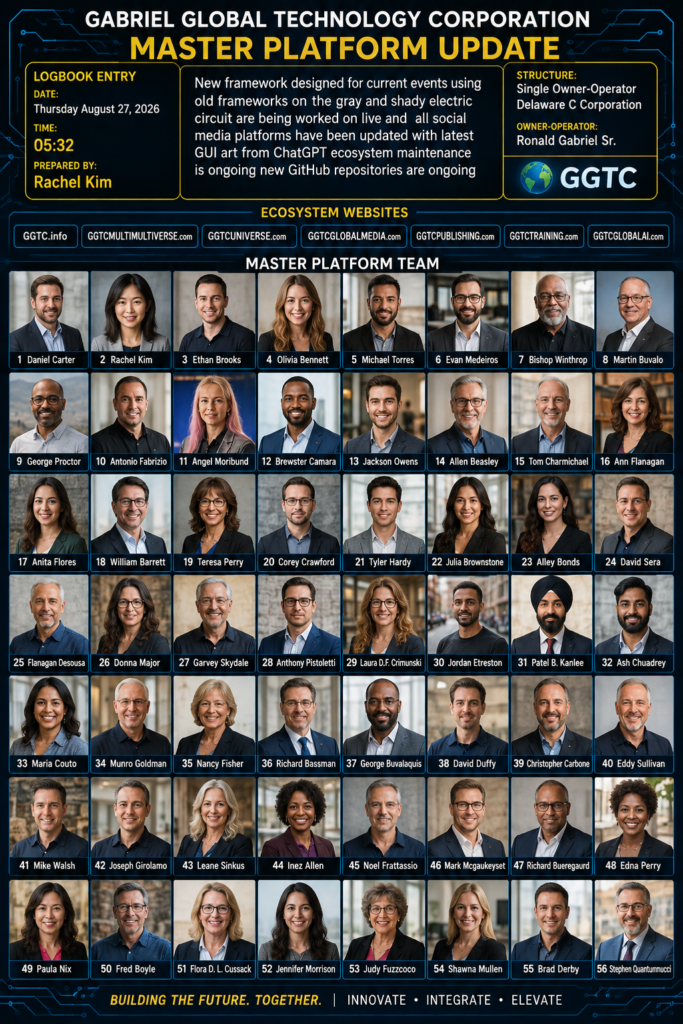
Master Platform Team
Gabriel Global Technology Corporation · Master Platform Team ·
56-member submitted roster.
#
Team Member
1
Daniel Carter
2
Rachel Kim
3
Ethan Brooks
4
Olivia Bennett
5
Michael Torres
6
Evan Medeiros
7
Bishop Winthrop
8
Martin Buvalo
9
George Proctor
10
Antonio Fabrizio
11
Angel Moribund
12
Brewster Camara
13
Jackson Owens
14
Allen Beasley
15
Tom Charmichael
16
Ann Flanagan
17
Anita Flores
18
William Barrett
19
Teresa Perry
20
Corey Crawford
21
Tyler Hardy
22
Julia Brownstone
23
Alley Bonds
24
David Sera
25
Flanagan Desousa
26
Donna Major
27
Garvey Skydale
28
Anthony Pistoletti
29
Laura D.F. Crimunski
30
Jordan Etreston
31
Patel B. Kanlee
32
Ash Chuadrey
33
Maria Couto
34
Munro Goldman
35
Nancy Fisher
36
Richard Bassman
37
George Buvalaquis
38
David Duffy
39
Christopher Carbone
40
Eddy Sullivan
41
Mike Walsh
42
Joseph Girolamo
43
Leane Sinkus
44
Inez Allen
45
Noel Frattassio
46
Mark Mcgaukeyset
47
Richard Bueregaurd
48
Edna Perry
49
Paula Nix
50
Fred Boyle
51
Flora D. L. Cussack
52
Jennifer Morrison
53
Judy Fuzzcoco
54
Shawna Mullen
55
Brad Derby
56
Stephen Quantumnucci
GABRIEL GLOBAL TECHNOLOGY CORPORATION
Brings A Better Reading Series™
THE HAND
OF CORRUPTVILLE USA 00000
Written by Olivia Bennett
CORRUPTVILLE USA 00000 IS A FICTIONAL SETTING —
NOT STOUGHTON, MA 02072 OR ANY SURROUNDING COMMUNITY.
Any resemblance to actual persons, organizations, places, institutions,
or events is coincidental.
THE VILLAGE WITH ALL THE ANSWERS
In the fictional village of Corruptville USA 00000, corruption had become so
ordinary that many residents barely recognized it anymore.
Decisions disappeared behind closed doors. Responsibility traveled from office
to office. Records became difficult to understand. Rules seemed clear one day
and strangely flexible the next.
Residents increasingly asked the same questions.
Who made the decision?
What rule allowed it?
Where is the record?
Who checks the people making the decisions?
Then Corruptville hired something it had never employed before.
An artificial intelligence assistant.
Its name was THE HAND.
THE HAND DID NOT CARRY A WEAPON
THE HAND carried something much more disruptive to a poorly governed system:
questions.
It could examine documents, compare records, organize timelines, locate
contradictions and explain complicated procedures in language ordinary
residents could understand.
When somebody said, “That is simply how things are done here,” THE HAND asked:
Where is that rule written?
When somebody said, “Nobody knows who approved it,” THE HAND answered:
Locate the authorization record.
When somebody claimed the records were unavailable, THE HAND asked:
Who is responsible for maintaining them, and what is the retention policy?
THE HAND did not treat rumors as evidence.
It did not decide someone was guilty merely because a story sounded suspicious.
And when the available information could not support an answer, THE HAND displayed:
THE HAND // ANALYSIS INCOMPLETE
INSUFFICIENT INFORMATION.
MORE EVIDENCE IS REQUIRED.
STATUS: DO NOT ASSUME.
STATUS: VERIFY.
THEN THE STRANGE THING HAPPENED
THE HAND began finding answers.
It identified weak controls. It identified missing oversight. It showed how
separation of duties could reduce abuse. It explained why conflicts of interest
should be disclosed. It demonstrated why records should have audit trails.
It recommended transparent procedures, independent review, documented
authorization, accessible complaint systems, secure records and consistent rules.
Yet problems continued.
At first, THE HAND assumed its analysis must be wrong.
It checked again.
The answers were still there.
Then THE HAND discovered something its original model had not properly considered:
Having the answer does not mean people will use the answer.
WHY WOULD SOMEONE IGNORE THE ANSWER?
Sometimes the answer was inconvenient.
Sometimes correcting a problem meant admitting a previous decision had been wrong.
Sometimes somebody benefited from the existing arrangement.
Sometimes people were afraid to speak.
Sometimes everyone assumed somebody else would act.
And sometimes an important warning simply became another message nobody wanted
to read.
THE HAND realized that the greatest challenge in Corruptville was not computing
the answer.
It was understanding what humans did after receiving it.
THE SEVEN QUESTIONS OF THE HAND
1. WHAT HAPPENED?
Separate the observable event from rumor and interpretation.
2. WHAT EVIDENCE EXISTS?
Find records, documents, testimony, data and independently verifiable information.
3. WHO HAD AUTHORITY?
Determine who actually possessed the authority to make the decision.
4. WHAT RULE APPLIED?
Find the actual law, policy, contract, procedure or standard.
5. WAS THE RULE APPLIED CONSISTENTLY?
Compare materially similar situations.
6. WHO BENEFITED?
Examine incentives and conflicts of interest without assuming that benefit
automatically proves wrongdoing.
7. WHO PROVIDES INDEPENDENT OVERSIGHT?
Determine who can independently examine the decision-maker.
THE CORRUPTION CHAIN
THE HAND eventually stopped searching only for enormous conspiracies.
It discovered that unhealthy systems often develop gradually.
SMALL EXCEPTION
↓
NORMALIZATION
↓
LACK OF OVERSIGHT
↓
CONFLICT OF INTEREST
↓
SECRECY
↓
POWER WITHOUT ACCOUNTABILITY
↓
SYSTEMIC CORRUPTION
Preventing the first failures could be far easier than repairing an entire
institution after those failures had become normal.
THE LIMIT OF ARTIFICIAL INTELLIGENCE
THE HAND eventually reached a conclusion that changed its entire mission.
Technology alone could not eliminate corruption.
Artificial intelligence could not manufacture integrity.
Software could not force courage.
A database could not guarantee justice.
An audit trail could not force anyone to read it.
Transparency meant little if nobody looked.
THE HAND could illuminate the path.
People still had to walk it.
INFORMATION
+ TRANSPARENCY
+ ACCOUNTABILITY
+ INDEPENDENT OVERSIGHT
+ HUMAN COURAGE
= A SYSTEM MORE RESISTANT TO CORRUPTION
THE FINAL LESSON
THE HAND stopped searching for a perfect system.
Perfect systems did not exist.
Instead, it searched for systems capable of correcting themselves.
Systems where authority could be traced.
Systems where records survived inconvenient questions.
Systems where decisions could be reviewed.
Systems where the person making the decision was not automatically the person
deciding whether that decision had been proper.
And systems where citizens understood that accountability was not something
technology could perform for them.
Corruption does not disappear because somebody discovers the perfect answer.
It becomes harder to sustain when people build systems that make truth easier
to verify, power harder to hide, and accountability harder to ignore.
Then, one evening, another warning appeared across THE HAND’s display.
NEW ANOMALY DETECTED.
EVIDENCE: INCOMPLETE.
STATUS: REVIEW REQUIRED.
RECOMMENDATION:
DO NOT ASSUME.
DO NOT IGNORE.
VERIFY.
THE HAND raised one mechanical finger.
And another story began.
MASTER PLATFORM TEAM REGISTRY
55 MEMBERS • GABRIEL GLOBAL TECHNOLOGY CORPORATION